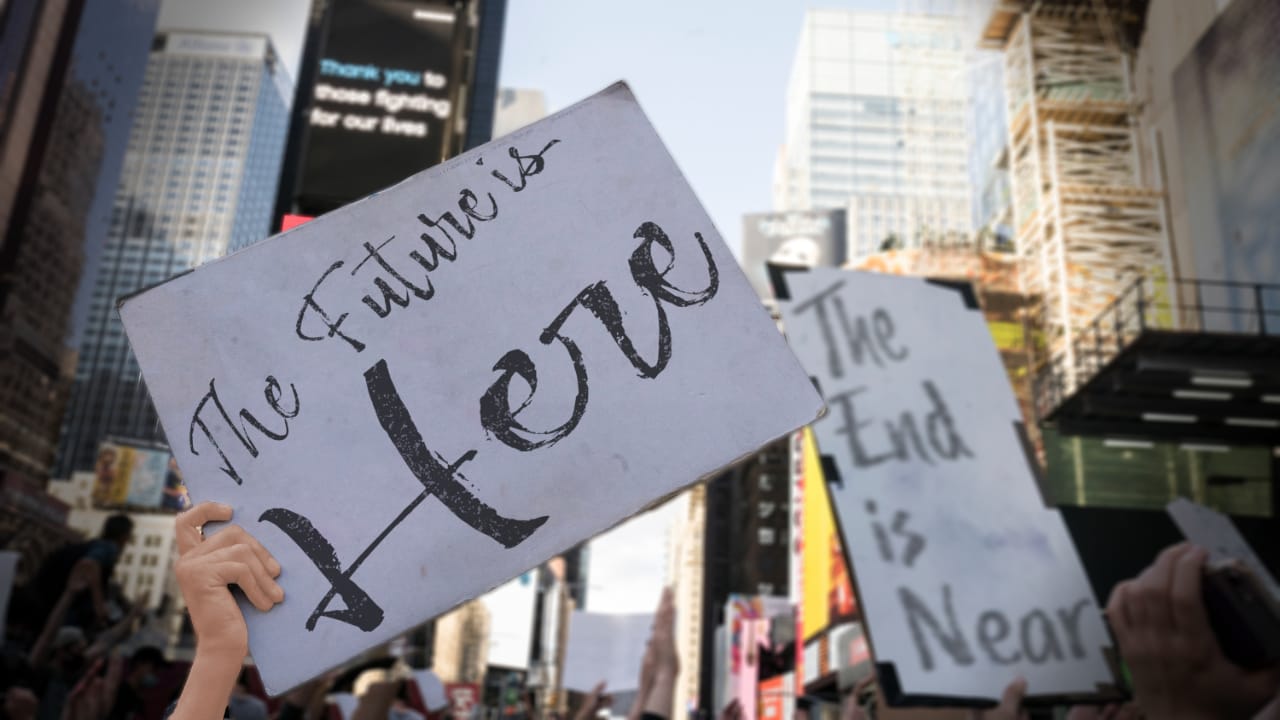
As Pastor Tim takes us to Matthew 24 for our new message series on the End Times, we need to think of two risks we face when dealing with the future: apathy and obsession. In contrast to these, Jesus instructs us on how to have the right mindset about the future.
The following study questions and transcript are AI generated and may contain errors.
The following study questions and transcript are AI generated and may contain errors.
Well, good evening, and welcome to Steadfast. I’m so glad to be here with you tonight as we begin a brand new series. This is a series on a topic a lot of us have questions about. What are the end times? What does the Bible say about the end times? How do we sort out all the different things we hear from different people about what the end is like, when it’s coming, if it can be predicted, all these things? There’s so much out there, and we want to know. We want to know how the story goes. And scripture tells us something, although it challenges us to look at it a different way than we typically do. That’s what we’re going to be thinking about throughout this series.
Let’s come before our God, ask for his guidance, and then we’ll jump right in. Let’s pray.
Father, thank you for your word. Thank you for the truth we find in it. Lord, would you guide our hearts that we would desire your truth more than anything else, and that as we read these words from our Savior, and we hear what he has to tell us about what will come, Lord, would you help us to stay focused on what is important to you, and not get distracted by the things that often do distract us. We pray in Jesus’ name, amen.
So our series is going to be coming to the end, but not by going to Revelation or Daniel or many of the places that people typically turn to for a series on the end times. We’re going to the Gospel of Matthew. As you see in the Gospel of Matthew, towards the end, near the crucifixion, Jesus takes his disciples aside and explains what is to come. It’s sometimes called the Little Apocalypse or the Olivet Discourse. And this two-chapter overview of the end times gives us a great deal of insight into what God wants us to focus on when it comes to the end.
It comes right after Jesus has been confronting the Pharisees and the other teachers of the law, the religious authorities and their hypocrisy, and how they’ve been focusing on things that are unimportant to God while disobeying God’s law in so many ways. And so he’s been challenging them, and then he takes the disciples aside and gives them a look at what’s to come. And we need to keep those two things together. Jesus is challenging both the disciples and those religious leaders to think more about what God truly cares about and less about what they care about. To think about what really is meaningful for advancing God’s kingdom and not the things they think are meaningful for advancing God’s kingdom.
And that’s what we see when we turn to Matthew chapter 24 and start with verse 1. Let’s take a look.
It says, “Jesus left the temple and was going away when his disciples came to point out to him the buildings of the temple. But he answers them, ‘You see all these, do you not? Truly I say to you, there will not be left here one stone upon another that will not be thrown down.’”
He sat on the Mount of Olives. As he did, the disciples came to him privately saying, “Tell us when will these things be and what will be the sign of your coming and of the end of the age.”
So they’re leaving the temple. Jesus has been challenging those religious leaders. And as they’re leaving, the disciples aren’t really grasping what’s going on. They’ve heard Jesus challenging these religious leaders, but they’re just marveling at the beautiful sights of the temple. It was a grand complex and it looked glorious. It looked powerful. Here was God’s physical representation on earth. Here was the power and might of the faith. And they’re looking at that and they say, “Jesus, don’t you see how beautiful these buildings are? Don’t you see how powerful this looks?”
Jesus says it’s going to be destroyed, it’s going to be taken away. Elsewhere in the Gospel of John, Jesus said that it would be torn down and then rebuilt. And they can’t get their minds around it. How could the power and the might and the glory of God’s kingdom on earth be torn down? And with the temple that essentially symbolized the nation of Israel, what was Jesus saying?
And so they assume, well, clearly he’s talking about the end. Because if the temple goes, so goes everything. Everything that matters, everything with meaning would be lost because they’re marveling. They’re like we are when we’re tourists, looking at the beauty of this building and thinking that’s what’s really important. So they asked Jesus this question: When are these things that you’re saying going to happen? We need to know because that is awful. And it must mean that you’re going to be coming right back in your triumphant, kingly role. You’re going to come and fulfill everything that we know that you’re going to do as Messiah Jesus, because if the temple is taken down, something big is going to have to happen. And we want to know when it’s going to happen, how it’s going to happen. Help us to figure this out, Jesus.
It’s the sort of question we still ask today. When is Jesus going to return? How is the end going to happen? And you can go on the Internet and find a plethora of different people offering opinions on that. And oftentimes what it really, I think, boils down to is we want to know, do we have time? Is the end near or not? Do we need to be focused really heavily reading our Bible every day or do we have time to just live our lives and deal with things later?
It’s sort of like if you’re in a car and you have that little fuel light, low fuel gauge come on and it lights up and you think, oh, I need to get gas. You know if your fuel, the little needle’s pointing at full or half or even a quarter and that light is off, you can keep going. And if you’re running late someplace, you can still keep going. You don’t need to stop and get gas. And maybe it’s about lunchtime, but you’re late for a meeting. And so you can think, well, I’m not going to get gas, I have plenty of time, I’ll eat lunch instead.
But then that light comes on and we start to get to know our cars and we know, well, I have X number of miles after that light comes on before I need to get gas. I know exactly when I need to be prepared until the gauge starts malfunctioning. If you have a car where the gauge doesn’t work properly, you can’t do that anymore. You can’t be preparing a little here and just when that light comes on, but the rest of the time just going with wild abandon and ignoring that needle dropping and dropping and dropping.
You have to be extra prepared. What we’re going to see as we go through these chapters is that’s the sort of preparation God’s calling us to in this life. Not the sort of preparation where we’re waiting for the little light to come on and then we know it’s time to get serious, but rather that we assume that the needle could go from full to empty at any time. We need to constantly be prepared. That’s what Jesus is preparing his disciples with. And he’s going to do that by talking about the horrible things that will come soon and the horrible things, the judgments that will come upon earth later so that they don’t just assume that they can keep waiting and everything’s going to go smoothly and there’ll be triumphs and victories and smooth sailing until that little fuel light comes on.
See, there are two risks for us as we look towards the end. The first risk is we have apathy towards it. We see that fuel gauge and the needle’s pointing to full. Everything looks like it’s under control and we are wrongly satisfied with how things are. And that’s really how the Pharisees and the Sadducees were and to an extent, I think, the disciples. Yes, they wanted to see Rome overthrown and there were people that were hoping that the Messiah would come and be a new newly triumphant political king who would take away the Roman oppression and things would be better. But they had their city. They had a region in Rome at least and they had their temple, and the temple was thought by many to be indestructible. It would never again fall. And so they were relatively satisfied.
Something that we can fall into too. We have our life relatively in order. Everything feels like it’s pretty well in order. We have a job we like. We have a house we like. We have friends and family that we love that are around us and everything seems to be going pretty well and we feel like that needle on our fuel gauge is pretty close to full and we know we have plenty of time. We don’t have any illness that seems to be threatening our lives. Everything’s good. All we need to do is know the signs so that we know when that light’s going to light up. And until then, things are pretty smooth. And that’s really what Jesus is confronting.
The Pharisees and the Sadducees in the previous chapter had been acting that way. They weren’t acting as those who saw an urgent need to see as many people understand God’s kingdom as possible. They saw the need to keep their power in place. And the disciples, as they’re looking at the temple, they saw this grand temple and it felt like everything is in order. Yeah, we’re excited about where you’re going, Jesus. We’re excited about what you’re doing. We can’t wait to see when you’re the triumphant king. But look at this amazing temple. Look at how big it is and grand it is. But the temple wasn’t the point. And so Jesus tells them, well, that temple is going to be taken away. That temple is going to be yanked out from underneath anyone that’s holding onto that and thinking that’s where their faith is located. That’s where their security is.
Because the security was not in the temple. The security was in the God who dwelt in the temple. And that day, as Jesus confronted those Pharisees and Sadducees, and they weren’t really interested in hearing the very God of the universe teach them, they were instead interested purely in maintaining the status quo. That God walked out of the temple and they didn’t even know it. And ironically, as the disciples are going with Jesus, they don’t even realize that they’re pointing out to Jesus the building and they’re with the true temple. They weren’t even getting that into their heads.
But what we see here in verses 1 to 3, as Jesus leaves the temple and goes onto the mount and looks over towards the temple, is a reenactment of what happened centuries before in Ezekiel 11. You see, as God’s judgment came down on Judah, we’re told that the glory of the Lord went up from the midst of the city and stood on the mountain that is on the east side of the city. In other words, the very mountain that Jesus was on. And so just as the glory had left the temple before it was destroyed the first time, so too Jesus had left the temple. And once again, their idol of the temple, this security blanket they felt like they could hold on to, and as long as the temple was there, everything was fine, was going to be taken away.
They needed to realize that the start of the end was near. Later in this chapter, we’ll get back to this again, but take a look at verse 34. Jesus says, “Truly I say to you, this generation will not pass away until all these things take place.”
Jesus looked to them and started to explain to them how this would happen, and he wanted them to understand that there were going to be things he was going to tell them that were going to happen in the immediate future. And then as we see as we’re going to go along, there are going to be things that were going to happen long after that. But what they really needed to understand first and foremost is that the security wasn’t in the temple, and it wasn’t in thinking their needle was full because the fuel light was about to come on, and they couldn’t any longer assume they could just look off into the long distant future generations later and assume that someday the day of the Lord would come.
Because as we see in the book of Hebrews, the end was about to begin. Take a look at Hebrews chapter 9 verse 26. It says, “For then he would have had to suffer repeatedly since the foundation of the world,” referring to Jesus’ suffering for us. But the author goes on, “But as it is, he has appeared once for all at the end of the ages to put away sin by the sacrifice of himself.”
We take a look at Acts chapter 2. Peter later understands this. Listen to what he has to say when he’s explaining what’s happening at Pentecost. He says, “In the last days it shall be, God declares, that I will pour out my spirit on all flesh, and your sons and your daughters shall prophesy, and your young men shall see visions, and your old men shall dream dreams. Even on my male servants and my female servants in those days I will pour out my spirit, and they shall prophesy.”
Peter at Pentecost, which is only weeks down the road from where they are at that moment when they’re asking Jesus what’s going to happen; having seen Jesus’ sacrifice on the cross, having seen the resurrection, having been restored by Jesus after he denied him, after experiencing these things and receiving the Holy Spirit, Peter looks and says, the fulfillment of the end has started. This day, he said, as he’s standing before the people, this day marks a turning point in the history of the world.
We can’t be satisfied with the things that we want to hold on to, that we think offer security, that we think are what really matter, because the end is near, but God is working spectacularly in that. The future isn’t something off in the distance. The future is here, Peter tells them.
The author of Hebrews, as he looks to the cross, doesn’t simply see something that happened 2,000 years distant from us. He sees the end of what the history of the world had been building up towards. And here we are, 2,000 years later, experiencing the massive ripple coming out of that. Jesus set off a tidal wave of salvation, of grace that would sweep the world.
And so, yes, the end can bring scary and terrifying things, but the horror of the end is the beauty of the salvation that pours out. And in Jesus’ message to the disciples, he’s going to be pointing them to look towards him, so that even as bad things happen, even as terrifying things happen, they’re looking towards that salvation.
The people around Jesus didn’t get that. The disciples, after receiving the Holy Spirit, did, at least to some extent. But we know as Jesus was being crucified, even, and in the trial leading up to it, what were people doing? They were mocking him. You said you were going to tear down that temple and rebuild it in three days. They didn’t realize what was happening right in front of them. They were looking to that building and feeling this false sense of security in it, when the true temple of God, when God himself incarnate in the flesh, was right in front of them.
Indeed, he would rebuild that body in three days, but they didn’t see it. And what would happen after that mocking? What would happen in the turn of the ages as they went into the last days? The temple would be gone. In 70 AD, just a few decades after Jesus’ death and resurrection, the temple would be destroyed by the Romans. Jerusalem would be attacked in the most horrible of ways, but Jesus would be alive. The real temple would be rebuilt. The fake facade of security would be gone.
And in that, Jesus was challenging them, challenging them in their sense that the temple represented a security of a nationalism that they could hold on to, that they had this nation. And even if the Romans were there, they were secure. He was challenging them in what we might call churchism, this idea that if we just have our institution, our building, our favorite decorations, our favorite hymnals, our favorite Bibles, our favorite whatever makes us feel secure in church, that everything will be okay.
He was saying those things aren’t necessarily bad. God established the nation of Israel. God established the temple. God has established his church, but when we hold on to the institutional trimmings and we see that as our security, and we’re not focusing on the one who has established those things as our security, we’re going to be sorely disappointed, just like those who were admiring that temple up to the day that the Romans laid siege on Jerusalem, and it would fall.
What happens when we lose our security blankets? Well, that’s what Jesus is going to address next, and that is the important thing that he needs the disciples to hear, because when that shaken, when it was shaken for them, and when those security blankets are shaken for us today, whether it’s our church or we’re looking at our country and we’re not sure where it’s going, we’re looking at our world and thinking, what’s happening to it? And our security blankets are shaken, we’re put at another risk, and that’s a risk of wrongful panic, a fixation on the end, in a sense.
When we lose our idols, when we lose those things that seem to offer us security, we go reaching for something else to give us security. Jesus tells them what’s going to happen so that they can be prepared and they can be focused on the right things, and in that description of what would come in the immediate future for them, it also gives us a warning.
So let’s take a look at verses 15 to 22 where he does that. He says, “So when you see the abomination of desolation spoken of by the prophet Daniel, standing in the holy place, let the reader understand. Then let those who are in Judea flee to the mountains, let the one who is on the housetop not go down to take what is in his house, and let the one who is in the field not turn back to take his cloak. And alas for the women who are pregnant and for those who are nursing infants in those days, pray that your flight may not be in winter or on a Sabbath, for then there will be great tribulation such as has not been seen from the beginning of the world until now, and never will be. And if those days had not been cut short, no human being would be saved, but for the sake of the elect, those days will be cut short.”
Now there’s some wrestling over exactly when this took place or will take place, but as we look at the overall chapter, this section appears to be talking primarily about the destruction of the temple and the siege of Jerusalem. And the description fits. The siege was horrible. It was humiliating, yes, but far more than that, it was absolutely torturous. It got so bad in Jerusalem as the Romans attacked and surrounded it and prepared to defeat the Jews that we have reports in the historical documents that we have describing it of mothers eating their children to survive. It was that bad. And the Jews would be scattered. The Christians who listened to Jesus’s warning departed Jerusalem before the final siege, but they too would suffer.
And in that was the fulfillment of that desolation, that desolation that occurred once before would occur again because the temple would be utterly destroyed and the pagan standards, the idolatrous standards of Rome would trample it. Be gone for good. They thought that temple was indestructible, but it was gone.
But Jesus says in this, don’t jump to false conclusions. Don’t go seeking after false solutions, even in this, because these are merely the birth pains at the end. The end is still to come. The temple is a part of a larger process.
Take a look at verses six to eight. Jesus says, “And you will hear of wars and rumors of wars. See that you are not alarmed, for this must take place, but the end is not yet. For the nation will rise against nation and kingdom against kingdom, and there will be famines and earthquakes in various places. All these are but the beginning of the birth pains.”
The siege of Jerusalem and all the rumors of wars and all the wars that have happened over history, these are birth pains of the end to come. And the suffering that we see in the late 60s and 70 AD, that period just a few decades after Jesus’s ascension, would be a symbol of all that was to come. The early Christians would know well suffering, but in that they’d know what it meant to look to the only solution.
There would be false Christs that would rise up, and they’d want to run to them, but Jesus tells them to resist that temptation. Take a look at verses four and five. It says, “Jesus answers them, ‘see that no one leads you astray, for many will come in my name, saying, I am the Christ, and they will lead many astray.’”
Many would be led astray. We see that even in the New Testament times that the apostles had to keep calling people back to faithfulness. And over the centuries after, as more wars and rumors of wars, as famines and plagues and earthquakes have happened, people have run off after those who offered immediate security.
What did the people need to do? They needed to do the same thing we need to do today, and they needed to receive the same power that enabled Peter to actually be able, just a few weeks later, to understand this. They needed the Holy Spirit. They needed God’s Word.
Peter, guided by the Spirit, what does he do at Pentecost as all these amazing things are happening? Has he seen what has happened and knows what will happen? He turns to God’s Word and hears what God’s Word promises, not about how to predict exactly when destruction would come or how things would exactly play out, the sort of things we like to do, trying to piece together numbers and patterns or things like that.
What does he do? He looks at God’s promises of his faithfulness, what God’s going to do. That’s what we’re called to do. Whenever we fail to do that, it doesn’t go well.
It was 10 years ago this week, in fact, that a global ministry called Family Radio predicted that the world was going to end. Jesus’ judgment was coming and with it, the end of the world. And the evangelist Harold Camping preached for a very long time in the lead-up to this how the world was ending, and many of the people who followed him toured the entire world proclaiming the coming judgment of God on May 21st, 2011, that it was going to come. The world was ending.
They put up billboards that said the Bible guarantees it because Camping had pieced together patterns he said he had found in scripture that promised this. It’s easy to get wrapped up in. And people were said to have sold their homes, given away everything they had because they were so sure the world was going to end at that moment.
But that’s not what Jesus calls us to do. Not to run to some false panic and be ready for some promised moment in history where someone says they’ve pieced together the right patterns, the puzzle pieces of history. Jesus doesn’t tell us the signs so that we can be prepared right before we run out of gas so that little gas indicator comes on and we swerve over and go into a gas station.
Jesus tells us what is to come so that we’re prepared and as we face things, we continually look to him because he’s the one that offers us security. He’s the only one that offers security to others. Our calling isn’t to try to predict the future with precision. Our calling is to trust Jesus as we face a future that doesn’t surprise us.
That was the apostles calling. It’s our calling today and as we go through this series we’re going to be thinking about how Jesus is preparing us for a future that doesn’t surprise us. Not because we find, oh, exactly on June 17th of a certain year the world is going to end, but because we know the patterns that are going to happen in this world. More than that, we know a God who is with us through them all, but none of this is overcoming his plan.
So let’s pray as we go through the rest of this series that we would hold on to that and that promise alone. Will you join me?
Father, would you help us to hold on to you and to the security we find in you? Would you help us to hold on to the gospel and the promises in it? Would you help us not to be too apathetic towards the end, feeling like what we have right now is all the security we need? Would you help us also to flee from the panic that would set in and cause us to follow false Christs and false predictions of the end, that instead we would see your word as guiding us and enabling us to stand firm? Lord, if we don’t have the only true security yet tonight, my prayer would be that tonight we would experience it for the first time. For those of us that do have that security, Lord, would you help us to hold on to it even more? We pray in Jesus’ name, amen.
If you haven’t experienced a security that is the only true security, not those false promises and predictions of the end or the things that seem so secure in this world right now, my prayer is that tonight you would trust in Jesus. Just as in that time the people needed to quit looking at the building of the temple and thinking that was what was going to secure them, they need to look to Jesus. That’s what we need to do today as well.
And if you’ve never done that, I would love for you to send me an email or leave a comment. I’d love to pray with you. There are others at Little Hills that would love to pray with you as well, because that is our hope and our promise. We need to focus on that more, and next week we’re going to continue that, thinking about the ways that we’re called away from the truth of the one true Messiah.
I hope that you’ll join me as we dig further into this series next week as we go through Matthew 24 and hear what Jesus has to tell us. It’s so important that we focus on the only hope, on the only security we have. And you can help by sharing this with others, because people want these answers. The answer’s right in front of us in God’s Word. It’s Jesus and Him alone.
Another way to do that, if you’re looking for a new Bible study, I’d love to see you on Thursday night. We have a wonderful men’s Bible study, and it just started in Acts, looking at how in this period of the last days, it starts with Jesus’ resurrection, that the church went out and boldly proclaimed, just as we’re called to do. And if you’re interested, feel free to leave a comment or contact me. I’d love to help you get connected on Thursday night to that. It’s at 7 p.m. on Thursday.
If there’s any way this week I can be praying for you, I can encourage you, please do reach out to me or leave a comment. And please do come back, and we’ll dig further in next week in Matthew chapter 24 and 25. I hope you have a wonderful and blessed week in the confidence and security of our Savior who is with us.
Start the Conversation