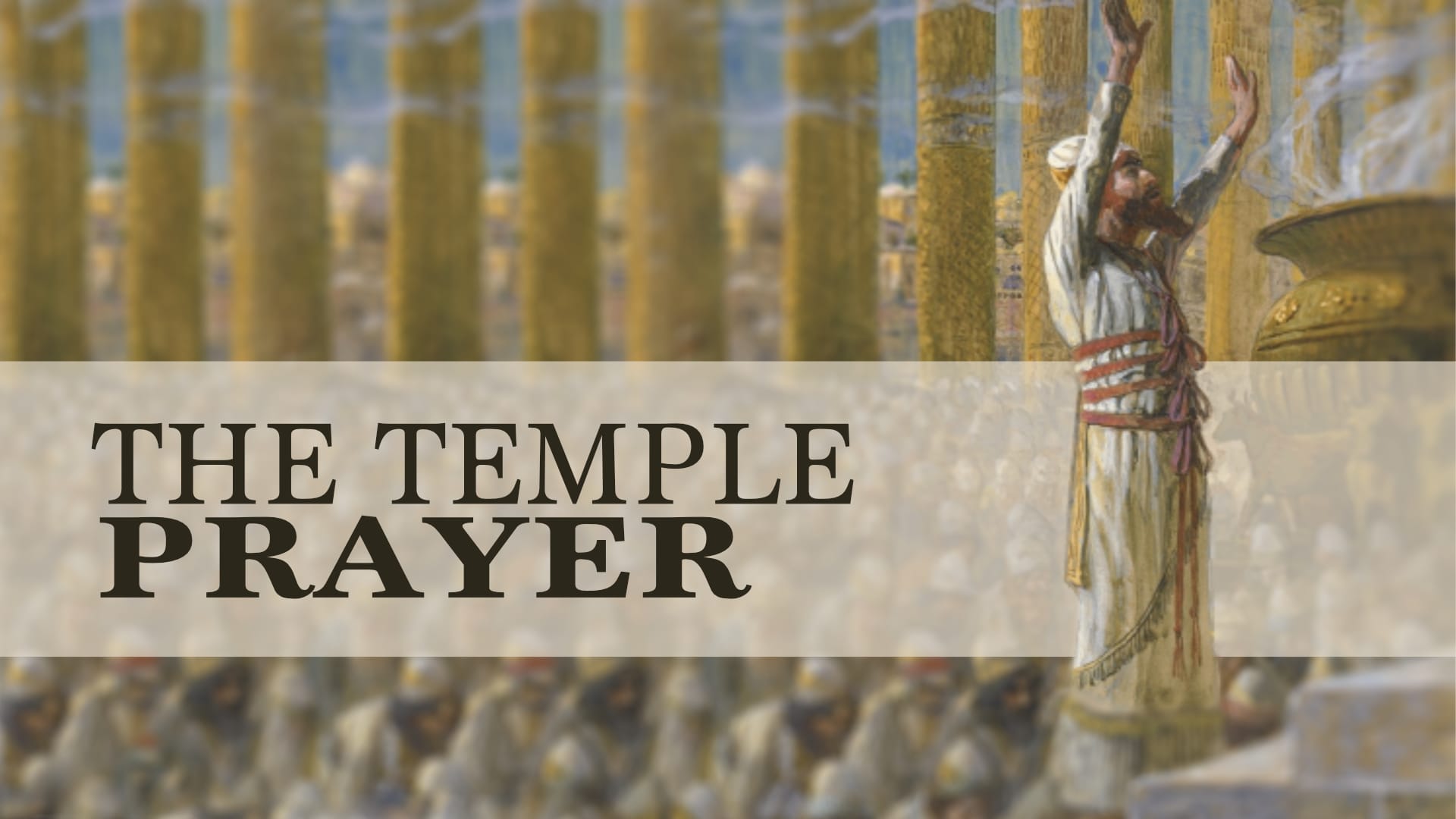
Failure and forgiveness. It’s in the center of Solomon’s temple prayer and it is in the center of our actions and God’s response to them.
The following study questions and transcript are AI generated and may contain errors.
The following study questions and transcript are AI generated and may contain errors.
Well, good evening and welcome to Steadfast. I’m so glad to be with you as we continue our series, The Temple Prayer. Tonight we’re thinking about repentance and God’s forgiveness. It’s a familiar topic, it’s an old topic, and so maybe if you heard about this topic before we started tonight, you were thinking, well, do I even need to hear another sermon, another message on repentance and forgiveness? It’s a basic fundamental truth of the gospel.
Yeah, I think we all do. We all need to be reminded of our need for repentance and also God’s gift of mercy. Now why talk about this when we’re talking about the dedication prayer of the temple? What we see tonight is that as Solomon dedicated the temple and he prayed before the Lord, what did he do? He turned to prayer as a means to speak to the Lord about the need for the people to be forgiven, forgiven for things that would happen years, decades, centuries after that dedication.
Solomon recognized the failures that all of us face, and we see this over and over again in scripture, this need to come before the Lord in prayer, but to come before the Lord in prayer, seeking his mercy. And so as we think about that tonight, and we think about how that applies to us in our own lives, let’s come before the Lord and ask for his guidance that we would see what he would have us to see. Let’s pray.
Father, we thank you that you give us the opportunity to come before you, to ask for your forgiveness, to seek your mercy, and that you promise to give that mercy to us. Lord, would you help us to see the areas that we need to confess tonight, and yet at the same time, to also recognize that you invite us to come, to not feel like we need to flee as we examine the uglier parts of ourselves, and we see parts of our heart that we wish we could hide from you. Lord, as we do that, would you remind us that you know these things, and yet you love us. You know these things, and yet you invite us to come. We pray in Jesus’ name. Amen.
I was listening to the radio a few weeks ago, and I heard them talking about so-called fast food hacks, how to go and order something and get something better than you normally would do. That you could go into different fast food restaurants, and you ask for menu items that maybe aren’t actually on the menu, and sometimes you’ll see these sorts of lists online. A number of the hacks involved asking for things in a somewhat unusual manner, but a manner that is thought to be common to secret shoppers for the different chains.
And so you go to McDonald’s or Arby’s or wherever, and you order something, and you ask for it in a way that a secret shopper would, so that the person behind the counter thinks you’re a secret shopper. Naturally, if you’re a secret shopper, you’re going to get the benefits of being a secret shopper. The person’s going to want to serve you, and it’s not going to matter if you’re extra nice to the clerk. It’s not going to matter if you came in at the right time or anything else. They’re going to want to serve you the best they possibly can, so that good report goes back to the corporate headquarters.
I don’t know if those so-called menu hacks actually work. I’ve never tried them, but it sounded kind of interesting. It’d be an interesting experiment, wouldn’t it, to go and order the same thing, and at one point order it normally, and at one point order it with this secret shopper lingo and see what happens. Apparently, people actually notice a difference. We might think that when we go into a restaurant, all that matters is if we have the money to pay for it or not, and that will determine whether we should get the admission that we deserve, whether we should receive the food in the proper, prepared sense.
And yet, what we see is that there are times where someone may put in extra work not because we have the merit, we have the money to pay for it, but because they think there’s some other reason to do so. There’s something else. The power of the corporation that we’re invoking, and that’s supposed to provide us with better food. What does that have to do with prayer? Well, so often when we think about prayer, we come to God and we’re thinking about the money, the merit that we can place before God.
What can we put in front of the Lord that would make it so that he would want to hear us pray? What can we do and say, Lord, I’ve done these things, I’m doing these things, I’m following your word, I’m studying your word, I’m doing this and that, and so now will you hear my prayer? Is that what really gets us the service that we’re shooting for, to actually be heard by the God of the universe? Well, we quickly realize in scripture, we can do as much as we want and our efforts still fall short. So no matter what we do, whatever we place in front of him, there’s no reason for God to hear us.
The clerk at the fast food restaurant should hear us because we’re paying for the food, but there’s nothing we can pay God. There’s nothing that he needs and there’s nothing that we do that would ever deserve it. And yet what does God do? Well, he may be the person listening to us, but he’s also the full authority of the corporation. And so when we come before God, what makes him listen is not our own merit, but it’s the fact that the corporation God himself has chosen to.
It’s not about us, it’s about that authority that God has, that he actually gives to us to come before him. And so we don’t need some kind of special hack of special words when we come and pray. We just come before him and we don’t need to live up to a certain standard before he hears us. We just come before him because he has already done the hack for us. He’s given it to us in the invitation to have Jesus as our Lord and Savior.
Now Solomon didn’t know about Jesus yet, but he did get this basic concept and we see that if we turn back to First Kings chapter eight and look at verse 28, Solomon says, “Yet have regard to the prayer of your servant and to his plea, O Lord my God, listening to the cry and to the prayer that your servant prays before you this day, that your eyes may be open night and day towards this house, the place of which you have said, my name shall be there, that you may listen to the prayer that your servant offers towards this place.”
What does Solomon say? He doesn’t say, okay, I have the cash or I have the credit card. I want to pay for this prayer and have you hear it, God. What does he say? He says, you’ve already promised. You’ve said that you care about your people. That’s the only reason that Solomon can come before God and say, please hear my prayer.
Take a look back at verse 26 we looked at last week. Solomon says, “Now therefore, O God of Israel, let your word be confirmed, which you have spoken to your servant, David, my father.” He realizes everything that’s happening is because of promises and he goes on.
At the very end of this prayer, he wraps it up going back to these basic truths. He says, “Let your eyes be open to the plea of your servant, to the plea of your people, Israel, giving ear to them whenever they call you. For you separated them from among all the peoples of the earth to be your heritage as you declared through Moses, your servant, when you brought our fathers out of Egypt, O Lord God.”
Solomon begins the prayer and he ends the prayer by saying, why am I before you, O God? It’s because you have promised, because you have called your people and so I can come before you. What does he say before he even is fully enmeshed in that prayer? He starts by reflecting on the promises that God gave his father, David.
And all this is so crucial to the dedication of the temple, because why does the temple exist? Why is Solomon dedicating the temple? It’s not because God was homeless and needed a house. He’s dedicating the temple because God has established this building to be something that people could look on and say, the God of the universe cares about us enough to dwell here.
He’s not only here, but his presence is here because he loves us. The temple existed to remind the people the God of the universe is accessible. There’s a way to come before him. There’s a way to have him hear our prayers. Now, of course, today we don’t have a temple. So you might say, well, I can read about this temple and it’s really nice, Tim, but how do I feel that same assurance today? How do I know that God hears my prayers today?
Well, back in this time, there was a temple, but of course, we know that that wasn’t the end of the story. Rather, a better temple was coming. And Jesus speaks about that temple in John chapter two. It says, “The Jews said to him, what sign do you show us for doing these things? Jesus answered them, destroy this temple and in three days, I will raise it up.”
And the Jews said, “It has taken 46 years to build this temple and you will raise it up in three days.” But he was speaking about the temple of his body. When therefore he was raised from the dead, his disciples remember that he had said this and they believe the scriptures and the word that Jesus had spoken.
What does Jesus say is the proof to the leaders of the people that the things he was saying were true that they could be trusted in? He says, look at me, myself, and you can look at me, you can look at my body and that body is going to be put in the ground. It’s going to be torn down and it’s going to be raised back up because I’m not going to be done yet. Jesus himself is the temple.
And so when we look at the life of Jesus and the promises we find in scripture about Jesus, what do we find? We find a living temple, not just a temple of stone, but God himself dwelling in the flesh, having come to this earth to be with you and to be with me.
And he hasn’t just done that 2000 years ago and then left us alone. Rather, what are we told? We are told in scripture multiple times that the church, the people of God are the body of Christ today.
When we think about the people of the church, when we think about the sacraments that God has given us to the sacrament of baptism that brings people into the church, the sacrament of the Lord’s Supper that we partake together and affirm the promises of God and experience a meal together. These things speak to the body of Christ here today. When we look at the church, we’re reminded of Jesus and when we look to Jesus, we see the temple of God.
Listen to what Paul says in 1 Corinthians chapter 10. He says, “I speak as to sensible people, judge for yourselves what I say. The cup of blessing that we bless, is it not participation in the blood of Christ? The bread that we break, is it not participation in the body of Christ? Because there is one bread, we who are many are one body, for we all partake of the one bread.”
So what do we see when we come together and we have the Lord’s Supper? We see two things. We see, first off, we actually get to experience a visible version of the promises of God. We partake of the body and blood of Christ through that sacrament. And as we do, we see that we’re doing it with the body of Christ, the people that God has called together.
And so we see there how much we need the church. We have all these wonderful internet resources. We can go online and study the Bible. We can go and find the greatest Bible teachers in the world and listen to them if we want. Why do we actually need fellowship with other believers? Why do we actually gather still as local churches? Why start a new church like Little Hills? Why do we need those things?
We do that because when we come together, when we see the body of Christ assembled, we see the testimony, the affirmation of the promises of God, just as that temple that Solomon was dedicating was an affirmation of those promises. And as we see those promises, it helps speak to us as we come before God and we’re called to repent before him.
Because here’s a problem. Sometimes we don’t think enough about the need for repentance. But sometimes we start to think about it so much that it weighs us down and we start to wander away. We wander away from other Christians and we wander away from the Lord himself because we feel like we’re just too flawed.
If we actually allow ourselves honestly to see the problems in our own heart, we can easily come to that conclusion. Well, why would God ever hear my prayer? Why should I be with God’s people? Why should I be a part of his people in any way? Because God’s not going to want me anyway.
But what do we see when we see those promises affirmed in the life of Jesus? What do we see when we see God assembling a group of flawed and fallible people together to worship him, just like he did in Israel as those people assembled before that temple? We see a reminder of God’s promises, promises that as Solomon comes before the Lord, he says, and say, look, I am the great and high and mighty king. Now, Lord, listen to me because I’m so great.
What does he say? He asks you to hear this prayer because you have promised to hear the prayers of your people.
So as we see the establishment continuing of that people today, we hear those promises and we’re reminded not that we deserve to have our prayers heard, but that God has promised to hear our prayers. And so we can come before him and we can repent. We can admit the things that are wrong and we can seek his forgiveness.
And it’s so crucial that once we recognize it, that we do it. We don’t just do lip service to seeking his forgiveness. The Lord calls us to come in repentance and Solomon goes over example after example because the two go together. They’re so crucial.
Take a look at verse 30. He says to the Lord, “And listen to the plea of your servant and your people, Israel, when they pray towards this place and listen in heaven, your dwelling place. And when you hear, forgive.”
He goes on a few verses later, “when your people, Israel, are defeated before the enemy because they have sinned against you. And if they turn again to you and acknowledge your name and pray and plead with you in this house, then hear in heaven and forgive the sin of your people, Israel, and bring them again to the land that you gave to their fathers.”
“When heaven is shut up and there is no rain because they have sinned against you. If they pray towards this place and acknowledge your name and turn from their sin, when you afflict them, then hear in heaven and forgive the sin of your servants, your people, Israel, when you teach them the good way in which they should walk and grant rain upon that your land, which you have given to your people as an inheritance.”
“If there is famine in the land, if there is pestilence or blight or mildew or locusts or caterpillar, if their enemies besieged them in the land at their gates, whatever plague, whatever sickness there is, whatever prayer, whatever plea is made by any man or by all your people, Israel, each knowing the affliction of his own heart and stretching out his hand toward this house, then hear in heaven, your dwelling place, and forgive and act and render to each whose heart you know according to all his ways.”
“For you only know the hearts of all the children of mankind, that they may fear you all the days that they live in the land that you gave to our fathers.”
Why does Solomon go over example after example after example of judgment? Because he looks at the people and in the wisdom that God’s given him, he knows that there’s going to be example after example after example after example of the people failing.
So as he comes before the Lord in prayer, as he dedicates this temple, a celebratory day, this is a wonderful day, so many years in the making, what does he do? He prays for forgiveness because he knows that that’s the centerpiece of coming before God is to come before him recognizing how undeserving we are and how merciful he is.
Consider what Jesus says in the Lord’s prayer as he teaches us how to pray, right smack dab in the middle of it, is confessing our sins and seeking to forgive others. Forgiveness, repentance, these things are tied in to the heart of prayer because they remind us of where we are situated before God. They allow us to place those burdens before our God and to experience the mercy that he desires to show us.
And each and every one of us constantly needs that. Solomon himself in his splendor says this in verse 46, “If they sin against you, for there is no one who does not sin.”
We’re going to take a look at the rest of that verse in just a moment, but think about that phrase for now. If they sin against you, for there is no one who does not sin. Solomon doesn’t even exclude himself.
He doesn’t try to make himself higher and mightier and say, well, if some of these more heathen-ish people out there sin, no, he realizes that he’s going to sin.
And if we look at ourselves, we realize that we’re going to sin, we would probably all love to say, well, I’m never going to do anything wrong again. And it’s good that we’d like to do that, and yet we will.
And so forgiveness and repentance come together in a good prayer. We see this demonstrated here, that even when we’re celebrating, we should come before God and recognize the place that we are in, that the celebrations themselves speak to God’s mercy, that he’s showing us mercy we don’t deserve.
And when we somehow yank out repentance and forgiveness from prayers, and we think, well, but that’s so depressing. Why do we want to talk about repentance all the time? Why do we want to talk about sin? Let’s just get rid of it and think about how good God is.
Well, we can’t fully understand how good God is if we don’t understand what he’s done for us. We need to go back to it time and again. Can I make you hungry for a second? Take a look at this.
How about some chips? Yeah, I wish I could upload them onto the web and you could download them and you could be eating some chips while we’re talking. I can’t figure out how to do that. But anyway, here’s some chips and tortilla chips are delicious.
But if you’re like me, doesn’t it feel like there’s something missing from this picture? Let’s fix it. Ah, that’s much better.
Chips need salsa, right? I mean, chips are great. Tortilla chips are wonderful. But if they don’t have something to be dipped into, they’re lacking.
And so often, something as good as prayer, something as good as coming before our God is lacking because we’re lacking one of the ingredients that God tells us time and again to bring with us when we pray to him.
That’s our repentance. That’s coming before him and saying, yes, I am really messed up, and here are the areas I’m struggling, Lord. And of course, God already knows those, but he knows that we need that.
Just as the people needed the temple, they needed to come before God, place those burdens before him, and experience directly God’s forgiving power.
And in that, we see both a communal sense, the people coming together and praying for the whole of the people, and also an individual sense. Sometimes today, it seems like we see people who want to say, well, prayer is, and repentance especially, is about praying for the corporate sins of our society.
And Solomon’s doing that here, right? He’s praying, in part, for the things that Israel as a whole is going to do and the punishments they’re going to come upon the land for doing them.
But he also talks about the individual heart and how much the Lord pays attention to what’s going on in each person’s heart. And part of the prayer is, forgive people as you know, Lord, what’s going on in their own hearts.
We see that in verse 39. So we see both.
And that impulse we have where you’ll see people and they’ll say, oh, we need to make sure that prayer is focused on the corporate and not the individual.
Or we’ll see people say, well, how dare they pray about anything corporate, any kind of corporate sin, because I didn’t participate in part of it.
What do we see? Both are a part of a healthy prayer life. We come before the Lord. We ask for his forgiveness for our corporate group of people and for the things going on inside of us.
And we do that with confidence that the Lord knows our hearts and he hears our prayers all the same.
Listen to what Solomon’s father, David, said in Psalm 139. He says, “Search me, O God, and know my heart. Try me and know my thoughts.”
That sounds kind of scary, doesn’t it? Look in me and see everything in me. Do we really want to pray that? Yes, we do.
And we see that time and again because the Lord does know us. And David, as he says that, he doesn’t expect that God’s going to say, oh, OK, well, I never looked in your heart before, but maybe I’ll take a peek now, David.
No, David knows that the Lord knows his heart. But David wants that.
That’s an expression of Lord, I want you to know my heart in all the ugliness of it and everything the flawed in it, because I know that you are a God of mercy and I know that the only way I get from where I am now to where you want me to be is to have more of you in me.
We sometimes even see where this inner heart focused part of prayer and repentance and the external repentance in our corporate body of Christ tie together and help each other.
And we see that, for example, in Hebrews chapter three, the author of Hebrews says, “Take care, brothers, lest there be any of you in any of you an evil, unbelieving heart, leading you to fall away from the living God.
But exhort one another every day, as long as it is called today, that none of you may be hardened by the deceitfulness of sin.”
As we gather together as a corporate body, what do we do? What are we called to do? We exhort each other.
We call each other to repentance. We should be helping each other. And we don’t do that so we can condemn other people.
Hey, that’s going to be someone fun to call to repentance.
That’s because we realize that we’re all sliding in the quicksand of sin and we need to help pull each other up.
That’s what God has placed us in the body of Christ to do, to serve each other, to experience the grace and mercy of God together.
But you might say, but what if I’ve wandered far off? I’m like the Israelites in exile. I’m often the Babylon’s of life.
Listen to what Solomon says in verse 46. He says, “If they sin against you, the people, once again, for there is no one who does not sin and you are angry with them and give them to the enemy so that they are carried away captive to the land of the enemy far off or near.
And if they turn their hearts in the land to which they have been carried captive and repent and plead with you in the land of their captors saying, we have sinned and have acted wickedly.
If they repent with all their hearts and with all their soul and in the land of their enemies who carried them captive and prayed to you toward their land, which you gave to their fathers, the city that you have chosen, the house that I have built for your name, then here in heaven, your dwelling place, their prayer and their plea and maintain their cause and forgive your people who have sinned against you and all their transgressions that they have committed against you and grant them compassion.
Compassion in the sight of those who carried them captive, that they may have compassion on them for they are your people and your heritage, which you have brought out of Egypt from the midst of the iron furnace.
And let your eyes be open to the plea of your servant and to the plea of your people, Israel, giving ear to them whenever they call it to you, for you separated them from among all the peoples of the earth to be your heritage.
As you declare through Moses, your servant, when you brought our fathers out of Egypt, O Lord God.”
What does Solomon say? He says, when the people are so evil, when they’ve wandered so far into sin, Lord, that you can hand them over to the enemy and they are no longer even in this land that reminds them of your promises.
When they look to the land, in other words, when they look back to the promises that God’s given them, hear their prayer. And Solomon doesn’t say this hoping to maybe change God’s mind, Solomon says this because he wants the people to hear it, to hear what he can confidently come before the Lord and ask.
God isn’t like a cell phone where when we get out into the wilderness, suddenly we see we have no reception and there’s no way to call when we have an emergency.
God is there. And David continues reflecting on that in Psalm 139. He says, “Where shall I go from your spirit? Or where shall I flee from your presence? If I ascend to heaven, you are there. If I make my bed in Sheol, you are there. If I take the wings of the morning and dwell in the uttermost parts of the sea and even there, your hand shall lead me and your right hand shall hold me.”
So remember, David is saying this in the context of what he said earlier, search my heart, see what’s in there.
And David doesn’t say then, well, if I flee, maybe I can get away from how you should react to me.
He says, no, wherever I go, wherever I stray, whatever I do, you’re going to be there with me.
You’re going to hold me.
It doesn’t necessarily mean that all the consequences of our sins go away. And Solomon recognizes that.
He doesn’t say when the people are carried off into exile and you hear their prayer immediately magically transport them back into Jerusalem and make everything great.
No, he says, give compassion to the captors that have captured them, that they might show some mercy to them.
Sometimes we’re going to be in wildernesses and we’re going to pray and we’re going to remain in a wilderness.
But even in that, God hears our prayers. And he calls us all the more to return to his promises.
We need to remember who we are in him and that we’re still who we are in him. Even if everything that we were counting on and everything that gave us security in life has fallen away.
Jesus came to give us a temple that wasn’t just in one place, but is everywhere. A temple that is placed in our hearts as the Spirit dwells inside of us. That’s what Solomon recognizes here.
He talks about the Lord teaching his people. What do we know that the Lord does through his Holy Spirit? He speaks his truth to us.
When we turn to his word and we read it, when we study it together, he’s teaching us and he enables us to hear what’s going on because of the Spirit working in us.
We’re never going to go too far away and he’s not going to be able to hear us. That’s what we’re told.
So we can come wherever we are and we can repent. When we fall down in the ditches of life, he will hear us.
I read a story the other day about a woman in England who’s 80 years old. She has a farm and I suppose she was out tending to her farm and she fell down into a ravine way off in a remote corner of the farm. No one would have ever found her.
And after the neighbors realized they hadn’t seen her in a while and they went looking for her, they looked all over. They couldn’t find her. Except for one very helpful little hero.
It’s Pyrrhon, the cat. Pyrrhon, it’s said, came up to the top of that ravine and he just meowed and meowed and meowed. He would go up to the different rescuers who were searching for this woman and he would meow and meow and meow until they finally decided to pay attention to what this little cat had to say.
What did this little cat do? This little cat led the rescuers down into the ravine and they found the woman. They were able to take her and get her the care that she needed to help her recover.
The Holy Spirit is with us just like that cat. Wherever we may be, the Holy Spirit utters groanings for us that we might experience the mercy of God, that his rescue might find us wherever we may be.
This may be old news. This may be the oldest news. We may have heard this a thousand times, but this is the best news. This old is true again and again and again.
God offers his forgiveness to you.
Will you join me in prayer?
Lord, sometimes we overlook the wonder of what you do. We overlook how you rescue us or we think that you might not.
Wherever we might be tonight, Lord, would you remind us of this wonderful old news that is still true, that you are a God of mercy who calls us to come before you with repentance. But in that repentance calls us to experience your love and your mercy.
May we all experience that tonight and every day we pray in Jesus name, amen.
Well, I am so glad that you’ve been here tonight. If you know anyone who would be encouraged by this message, consider sharing it.
You can make a difference by sharing it on social media or personally send an email, make a phone call, invite someone over and share this message with them.
I think we all need to hear more about God’s forgiveness every single day. We need to be reminded that he is a God who forgives us wherever we may be.
And then he hears the rest of our prayers too.
Next week we’re going to be thinking about what do we do when we come before God and we pray that things would happen, that we would have victory in whatever battles we’re facing in life. What does that look like? That’s what we’re going to think about next week.
So I hope you’ll join me for that on Monday at 7 p.m., but in the meantime, please do mark your calendar for Friday because Friday night at 7 p.m. we’re having Faithtoberfest.
You can go and pre-register at faithtoberfest.org. There’s even a way on there when you register, you can go to Prize Central and send out a customized, personalized link and gain extra chances to win prizes by referring others to hear about Faithtoberfest.
Please visit faithtoberfest.org and be there Friday night and I’ll see you again next Monday as we continue to think about coming before our God in prayer.
Hope you have a wonderful and blessed night and a wonderful week.
Start the Conversation