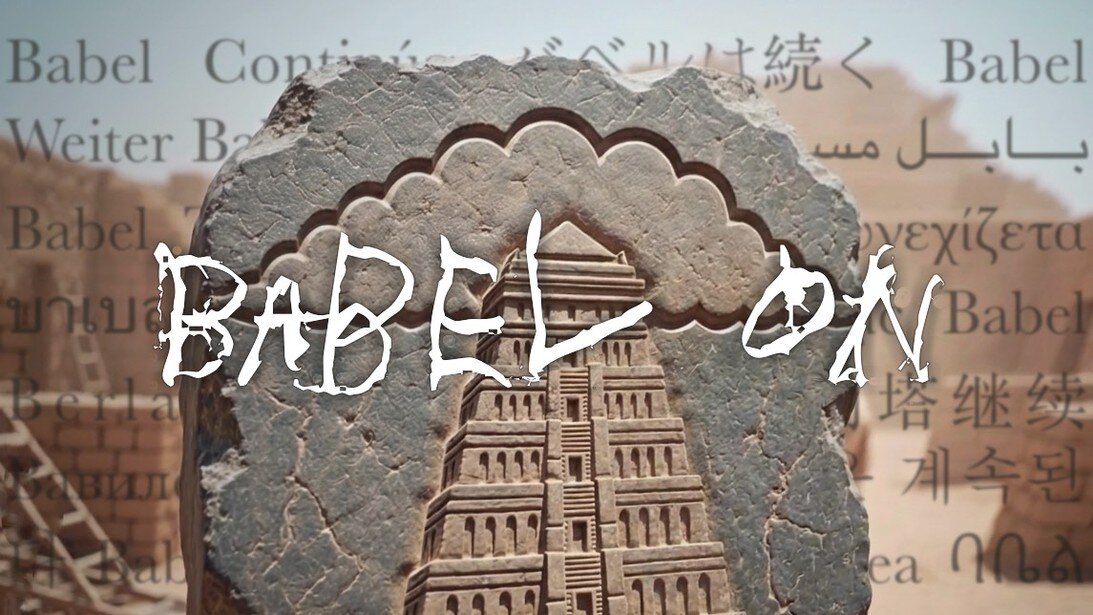
When we struggle to translate from one language to another, we’re painfully reminded of the problems coming from the Tower of Babel. But do we remember the temptation of that situation, one that plays to our own ambitions still today?
The following study questions are AI generated and may contain errors.
The preacher says the problem isn’t that people can build bricks—it’s what they do with them. What are some “bricks” (abilities, talents, positions) that you have, and how do you discern whether you’re using them to glorify God or to build your own monument?
Where in your own life do you notice the urge to “build a name” for yourself rather than for God’s glory? What does it feel like when you catch yourself doing it, and what helps you reorient?
The sermon uses the image of wrapping a poor report in an attractive cover to hide mediocre work. Can you think of examples—in your own life or in the world around you—where impressive presentation or language distracts from hollow content or bad intent?
God mocks the tower by saying He has to “step down” to see it—implying how small and insignificant it is compared to His creation. How does gaining God’s perspective change the way you evaluate your own accomplishments or the things you’re tempted to be proud of?
The preacher argues that nationalism arose from secularism and represents an attempt to glorify human power rather than God’s kingdom. How do you think about the balance between healthy cultural identity and the danger of making ethnicity, nationality, or ideology primary to your Christian identity?
The sermon connects the Tower of Babel to ongoing human fragmentation and brokenness. Rather than just lamenting division, what does it look like to use whatever abilities or position you have to point people toward Jesus as the source of real unity and grandeur?
This transcript has been automatically generated and may contain errors.
A while back, someone was preparing to go on a tropical vacation. Maybe you’ve done this. The person was trying to understand how to get around the island and what the appropriate things to do were, where things were, and had used Google Translate to translate the information about the location that the trip was going to be on. Google Translate, you know, it’s pretty good. It’s gotten even better. This was about 10 years ago. But the person translated this document, which was written in Spanish, or was given a translation of it that had been written in Spanish, and started reading the English.
Now, this was a volcanic island. The warning that they encountered getting to that part on how to deal with the fact that it was a volcanic island went like this: In case of volcanic eruption, you will hear mermaids. Do not ignore the mermaids. They are there for your safety. Now, if you read that first, you think, mermaids? What do mermaids have to do with volcanoes? It’s so good to know that mermaids are public safety conscious, and they alert everybody if there’s a volcano erupting. I’m sure they come all to shore just before they dash away from the lava heading to the ocean, and they say, watch out, the volcano’s exploding!
Well, so far I’ve not seen any video footage of these safety-conscious mermaids. What’s really going on? Well, in a lot of romance languages, the term for a siren, as we’d call it in English, is very similar to our word siren, but so is the word for mermaid. So, it wasn’t so much that these half-fish, half-human creatures were saving people because they were so conscientious about public safety. No, it was talking about something as average and expected anywhere as a warning siren, the sort of thing we hear every month when they test to warn us or to prepare to warn us about tornadoes.
We run into all kinds of things like this, don’t we? Maybe you order something online that comes from China or someplace like that, and they didn’t pay an actual native English speaker to write the manual, and you’re trying to figure out, what do these words mean? Or you encounter someone who’s traveled from out of the country, and you try to figure out how to explain something to that person, even though he or she doesn’t fully understand it. And the conversation ends up being sort of like saying, listen to the volcano warning mermaids. What? How am I supposed to understand this?
Hi, welcome to Steadfast. I am so glad you are here tonight as we begin a brand new series, Babble On. We’re going to be looking at the story of the Tower of Babel from Genesis chapter 11 over the next three weeks, and as we do, we’re encountering the epicenter of the language crisis in which we all live.
We know that problem and we may get frustrated. Maybe it was when in school you had to try to learn a foreign language. Maybe you succeeded, maybe you didn’t. Or if you’re working at a company, maybe you still are trying because that company has people in a different part of the world, and it would be really useful if you understood that other nation’s language.
We encounter problems with language all the time. Even within our own language, it’s constantly breaking in pieces, and it only takes, say, meeting someone from a heavily-accented part of, say, England, where we say, wait, are we still speaking the same language? Or maybe even certain parts of the United States. It’s kind of evened out over the mass media era a bit, but certainly there are lots and lots of variations.
For our southern campus, they know the pains of moving to a different country, living in Mexico, and having to learn a language and actually achieve enough of a proficiency at it to be able to live life in a country that doesn’t speak English as a primary language.
We’ve all encountered, one way or another, the problems of language. But do we actually get the lesson from that? Because, you see, we’re told, going back to the Tower of Babel, why it happened, what went wrong, why it is that humanity has all these languages, and we can trace the family tree of these languages further and further back and see their interrelations, but why did they break up, why did they break up, and why do we have so much trouble talking to other people? That’s what we’re going to be thinking about.
And as we’re going to be thinking about that, it’s not going to just be, well, here’s the challenge of learning a language. No, what we’re going to be thinking about is, what was it that God was saying to the people back then and to us right now that comes from that? That trouble that we continue to feel every day when we’re not sure what the volcano mermaids are.
Would you pray with me, please? Father, thank you for this evening. Thank you for this opportunity to dig into your word. Would you help us to have clarity as we encounter your word that in our own use of language, it wouldn’t be confusing but constructive. Would you help us to be pointed to the one who is the source of all truth and who will heal all things, even the brokenness of language. We pray this in Jesus’ precious name. Amen.
If you’d give this a like or a share as we get started, there’s probably someone who is right now struggling with something with a language and thinking, why do I have to do this? And it would be a great time to share and say, well, let’s talk about what the Bible says about language, because you know what? It points us to a problem, and it points us to hope. And that’s what we all need. That’s what we’re all crying out for.
Well, let’s go ahead, if you want, turn in your Bible to Genesis chapter 11, and we start out verse 1.
Now the whole earth had one language and the same words. And as people migrated from the east, they found a plain in the land of Shinar and settled there. And they said to one another, Come, let us make bricks and burn them thoroughly. And they had brick for stone, bitumen for mortar.
So the people get together, and they put their heads together, and they come up with a plan. And that plan, notably, as we’re in the early history of humanity, is in part expressing a really encouraging idea. We have abilities. We can see that.
The other day, the latest attempt of the SpaceX starship launched made it to space. I look at one of those giant spacecraft, and I think, wow, or we talked a lot about Artemis a few months ago. You think about it.
Do we have abilities? Yes, we do. If you think about the fact that I’m able to talk to you tonight, and we’re not all in the same room, we’re not even all in the same country. Do we have abilities? Yes, God has blessed us with abilities, and we can put our heads together and accomplish things.
And so that’s what we see here as a start, right in the midst of the connecting of the first part of Genesis, the story of Adam and Eve and Cain and Abel and the generations thereafter, Noah’s flood, and then moving from that into the preparation to talk about Abraham and that mission of salvation that God gave Abraham and his family. So we’re at that hinge point, and there’s two chapters of genealogy, and in the midst of that genealogy, we find ourselves here in chapter 11, verse 1.
And it can feel a little jarring, right? If you were reading straight through, maybe you did a Bible reading plan, and you start at the beginning of the year, you’re reading through the first chapters are all mostly narrative and easy to get into, and then chapter 10 is a bunch of genealogy, and then you come up for air, here’s the story of the Tower of Babel, then you go back down in the latter part of this chapter, more genealogy, and then we get to the story of Abraham.
Why is that? Well, because these genealogies and the story of the Tower go together. They’re not separate things. They’re not even happening necessarily in the order you see here, because what we can see in chapter 10 is that chapter 10 is telling the family tree both before and after what happens at the tower. So if you look at the two chapters together, one is the big picture view, and then we get, well, how did all this happen? How did this mess that starts to occur happen? That’s what we see in chapter 11, first part of it. These people putting their heads together.
We see lots of that in these genealogies early in Genesis. For example, in chapter 10, we see Nimrod, who was a great warrior. He leads people, and what does he do? Well, he leads to the founding of the town of Babel. Hmm, isn’t that interesting? That town that over time we know as Babylon. Babylon is a town that is infamous, rightly so, right? It’s the place that Jews are taken in exile, but it’s also the symbol of general evil in the scriptures.
Even in the New Testament, when the New Testament writers want to talk about Rome, how do they often refer to it? They refer to it as Babylon, harkening back to this. But Nimrod at first sounds relatively innocent. He’s a mighty leader or a hunter. Doesn’t sound so bad.
The people here, oh, we can build bricks. We’ll build something. We’ll build a city. That doesn’t sound so bad, does it?
So what we see here is a lot of things that on the surface aren’t so bad, like so many things that we do today. Not so bad. But in that family, we see something really interesting. Noah’s one son, Shem, has a son named Eber. Eber has two children, one named Peleg, who we’re going to come back to in a couple of weeks because, well, he’s in the family tree of Abraham. But his name means divided. And so we get pretty good sense there. When did this division happen? Well, about that time, right? That’s when it’s happening.
That’s also then when Nimrod is leading people, building the city. And the other son, well, we don’t talk about him as much because he doesn’t go with God’s people. He’s going to find some of those people that oppose God’s people. He’s part of the society that wants to elevate itself rather than God’s plan.
So really when you think about it, what this is describing is the abilities, it’s not condemning the abilities. The problem isn’t that the people can build bricks. That’s not it at all. It’s what are they going to do with those bricks? That’s the same question all of us confront every day, right? What are we going to do with the bricks that we can build? The abilities that we have, are we going to use them for God’s glory or are we going to use them for something else?
That’s what we’re challenged to do. With the backpacks we did a few weeks ago at the pool party, the church picnic, and then we got to celebrate the next day when they were all filled and they went off to Jerry Satterfield’s school to help some kids there and remind them that Jesus loves them and that we as a church love the people of our community.
And we got to do that. It was really great. And one of the things, I’ll admit, I had a little bit of fun with, I always enjoyed looking at school supplies, getting school supplies, the smell of the school supplies, right? They’re awfully wonderful things. A lot of them, even the ones that as a kid I didn’t really know what I was going to do with, and some of them I’m really not sure how useful they are even today, they’re still neat, right? Going to the office supply store. There’s so much neat stuff in there.
I can just smell it talking to you. And if you’re like me, you may have fond memories of that. Maybe it’s the pencil boxes or those composition notebooks or the fun folders with silly pictures on them, whatever it might be.
But one thing I found that I don’t know any useful use for, but a lot of people like to get, are report covers. And why do they like to get report covers? Because you can wrap your report in it and it’s supposed to look better, right?
When I was teaching, students would hand in their reports, even though I said just staple it in one corner, hand it in that way. No, they wanted to hand it in with a report cover, because it looked good, right? It looked profound. They could use their abilities, go to the office store, they knew about these things, and they could use these things. And I thought, well, this will make this impressive. It will demonstrate my competence in this, or how much I should get a good grade or whatever.
But it also sort of meant, and maybe you won’t notice the fact that stuff inside of it isn’t particularly good. Because without fail, the people that would turn in the paper, despite me saying you didn’t need to, with a report cover, their papers were not very good. They put their ability into going and finding a pretty cover, putting the paper in the cover, maybe choosing a really nice font that happens to take up a little more space, doing all that stuff, rather than doing the thing that was actually supposed to be done.
Maybe you’re feeling a little guilty, because you remember doing this at some point.
And so I think, well, why is this here? And maybe there’s a really genuinely good reason to have report covers. I don’t know. But the point is, what are you using them for? If you’re using them to hide the fact that you didn’t do the really important thing, that’s not so good.
If you know how to build bricks, and you use them to God’s glory, and it’s a wonderful thing, that’s great, but if you use them for something else, which is what we see they’re going to do here, it’s not so great. They’re wrapping their evil deeds in a report cover and hoping no one notices. They just get praise for the fact that they made it look really impressive. Something that we all need to ask ourselves, what am I doing with my abilities?
What today, using the gifts and abilities and position that God’s put me in, have I used that glorifies Him, rather than me? Because it’s so easy to get misaligned. It’s so easy to get wrapped up in the things that we want to champion and get obsessed with and focus on and pour energy into, that we lose sight of the fact that we’re just slapping a report cover on a pretty lousy report of our use of our abilities.
That’s what the people here at the Tower were about to do. And sometimes, sometimes it’s more than just getting misaligned. I’m giving us the benefit of the doubt here, but a lot of times we know full well what we’re doing. We want to do it anyway, because, well, we have bad intent.
That’s what we see if we go on to verse 4. Then they said, Come, let us build ourselves a city and a tower with its top in the heavens, and let us make a name for ourselves, lest we be dispersed over the face of the whole earth.
And the Lord came down to see the city and the tower which the children of man had built.
We have bad intent. You see, it’s not just that they want to build something. Nice shelters for themselves, even a really pretty city. They say, let’s build something to demonstrate how powerful we are and so we can stand against really our mission, right?
What did God tell Adam and Eve to do? Be fruitful and multiply. They’re supposed to go out and fill the earth, right? Their family was supposed to expand and grow from generation to generation and to fill the earth.
Well, maybe we’d rather not do that. On top of that, they say, we can build a tower that will reach to the heavens. Maybe they’re a little extreme, but I think they’re really serious about this. We’ll build something so tall that even God or the gods, depending on how aware they are of who God is, God or the gods or spirit beings or whatever is out there, they will see it and they will look at our triumph and they will say, look at these amazing people.
They can do more than build bricks. They can build giant, beautiful structures that unify the entire human race around its abilities. Our grandeur.
Some commentators, and I think they may have a point here, weren’t really talking about that the people thought they’d never spread out and take over more land, right? Urban sprawl is not a new thing. It’s throughout all of history. Humanity has grown in population. People move out and find more land. But it seems like the thought here is we’ll build this tower and everyone will know how great we are, no matter how much of the earth we cover.
Overall, they will know that we are great because we built this. It can be seen. And it will be seen forever and ever.
Now, if you’re familiar with the ancient Near East, maybe if you’ve watched a special on that region or maybe you’ve read a history book on it, you may have encountered the term ziggurat. A ziggurat was an artificial hill. They built a hill specifically to be a temple. And a lot of people say about the Tower of Babel, it seems like basically a ziggurat.
I think that’s likely true because guess what? Babylon had an impressive ziggurat. And this ziggurat was thought to bring the glory of heaven and link it to the glory of Babylon. It was called Etta Menachai. And it was thought that there, the gods, the Babylonian gods, would be able to connect with the humans. Of course, the king is the leader, as the divine son of the gods that leads the people.
And that Babylon’s glory would be seen. It seems, even after language was scattered, that the basic idea that you could build something that would bring glory through its creation hadn’t been lost. They still were holding on to this.
So, sometimes we not only have bad intent, we hold on to it. We’re not going to let go of it. And doesn’t that sound familiar? Aren’t there plenty of times all of us know, this is a really bad idea of what I’m doing, and yes, I’m going to keep doing it. We know that. We do that.
Now, the way I’ve laid this out is really important because it captures something about what Scripture’s talking about that’s contrary to some things that people are trying to suggest today.
It’s not bad for humanity to spread out. It’s not bad for humanity to create things. What’s bad is when we try to bring glory to ourselves. That’s the key problem here.
Now, I was talking to someone a few weeks ago who said, well, the separation of languages, that wasn’t a bad thing. They were already supposed to do that. Take a look at Genesis 10. That’s why I said it’s really important to understand the Tower of Babel’s happening in the midst of Genesis 10.
Sometimes today we want to talk about nations as if they are themselves the point of glory in this world. We see lots of people tossing around terms of nationalism. And let’s say something very clear. If you look at history, nationalism has always been intended to break the power of the Church. Why? Because it says the power of my people and their glory is greater than the universal glory of the body of Christ.
Nationalism arose out of secularism. And what we see before the Tower of Babel as people are spreading out, yeah, there are clans and tribes. But the breaking apart of society where there isn’t a unified society anymore is a punishment. Our fragmentation is a punishment. It is not a glory. We turn it into a human glory.
But what do we do then? We’re trying to build our own little Towers of Babel, just like the Babylonians did. Well, okay, we’re all split off now, but we’re still going to build our ziggurat and talk about how great we are. We’re missing the point.
Whenever we cling to our earthly identity as primary so that we’re something hyphen Christian, we’re missing the point. Our allegiance, our hope, the only thing that ultimately matters is that we are Christians, that we are saved in Jesus.
If we’re holding onto this other stuff and trying to build glory, we’re back to that bad intent that brought about the confusion of languages. We see the continued suffering today.
We can’t build glory to ourselves. And every time we see the brokenness of this world where some of us speak one language and some of us speak another language, some of us have this culture and some of us have that culture, it’s not that there are all bad components in that, just like bricks aren’t sinful or anything. It’s not all bad.
But here’s the problem. As we look at that, as we look at that, are we embracing it to bring glory to ourselves? Are we saying, let me use whatever the best parts of that are to glorify God? Two very profoundly different things.
I think a lot of it boils down to what we might do with some of those school supplies. Maybe when you go as a kid to the store and get your school supplies, you got a few things that you maybe didn’t absolutely need for school. Maybe you like to draw. I like to draw, and so oftentimes we come home with a few extra pens and pencils and crayons and things that weren’t strictly necessary for school, but I could do all kinds of fun things with, right?
You never know what you can do with one of those little pens that has all the little levers in it that you can push down and get different colors all out of one pen. They’re so amazing, right?
So, okay, I’m going to draw this picture now, right? And so you get out your notebook and you get out your pen and you draw this picture, and as a kid you look and think, wow, I drew this really great picture. Look at all the colors. It’s so great.
Objectively, was it good? Did any art collector contact you and say, can I hang that up in the Louvre? I’d like to buy it for my personal collection and put it on loan because everyone’s going to want to come and see it.
Of course not. Relative to your abilities as a kid, maybe it was pretty good, right? None of us are masterful artists as young children. But was it actually a creative masterpiece, a triumph of human ambition, full of grandeur? No. No, it wasn’t, right? We know that.
We can look back, and oftentimes we don’t like to look at the things that we actually made when we were young because we look at it and think, that was kind of bad. I can’t believe I thought it was good. What we need to understand is comparatively to God and His glory, everything we do is like that at best.
It’s actually even a further separation. But the thing that you remember being proud of as a kid that you look back on now and you think, boy, I don’t want anyone else to see that. Think of that every time we think of the things that we try to glorify ourselves with, whether it be our culture, our personal accomplishments, our associations, our companies, and resumes.
Whatever it might be, they’re not really that grand. And so every time we take our abilities and say, well, let me build a monument and a tower to myself, or to the people who speak like me or think like me, or to humanity even as a whole, right? We can turn that into an idol too.
We’ll reunify all of society and we’ll try the whole tower, Babel thing over again. Whatever human focus we do, it’s bad intent and it looks ridiculous if we can measure only objectively.
We need to get perspective. We need to get a God’s eye perspective, which is what we see here.
Because notice something. We often go whizzing past. Just look again for a moment. I want to take us back to the end of that passage.
And the Lord came down to see the city and the tower which the children of man had built.
Now, God’s everywhere. What does it mean saying the Lord came down? That’s God being sarcastic. They said they’re going to build a tower to the heavens. And God looks down from heaven and says, I’m going to have to step down there because I can’t see it.
What is that tiny thing that you guys are all making a fuss about? I will come down and see the tower that you guys have built.
It’s biblical sarcasm at its finest. God’s mocking their tower. Why? Because they think they built this grand thing showing their power, showing their ability, showing how great they are and how they can triumph and hold themselves together and make themselves the heroes.
God says, do you realize how tiny this thing is? Let me step down and peer at it with a microscope. It’s really, really small. It’s nothing. Have you seen the universe that I’ve built? It’s nothing. Do you really want to focus yourself on that?
That’s the challenge we still face today. It’s a challenge every time we struggle with language we ought to come back to. Be reminded that our natural human inclination is to glorify ourselves.
And this brokenness that we see, I’ll get more into that next week, but this brokenness that we see isn’t just to make things hard. It’s to remind us as we struggle to work together as human beings that yes, as humans, we should work together for the glory of God, but in our own fallen human state, what do we do?
We don’t work for the glory of God. We work for that attempt to glorify ourselves. And we look to our abilities, not realizing how limited they are. And we try to emphasize those, and we think we’re doing something so great, and we think that we have the thing that’s worth holding on to.
And if we’re not talking about Jesus, then we’re wrong. Some tiny speck. Some inconsequential thing. How about not seeking your own grandeur? Because when you do, you have bad intent. You’re shoving a bad report in that cover. And it doesn’t make it a good report.
Whatever abilities you have, they aren’t that impressive. And put to bad use, they’re really not impressive.
But this isn’t something where God just wants to insult us. Notice that God doesn’t direct that sarcasm earlier to Noah. He doesn’t direct it to you and to me. He says, why don’t you turn to me instead?
You don’t need to look to a tower, build your human monument of wonder, whatever it might be. Whatever it is that you or I would like to build today, you don’t need to look at that. Look at Jesus. There’s nothing more grand. And we’re invited into that grandeur.
We’re seeking grandeur. But when we seek him, guess what? We find the real grandeur.
Would you pray with me? Father, we thank you for your love, for your kindness. That yes, we see this problem here. We see the judgment that comes that we’re going to be getting deeper into next week. We see that, and it’s painful, and it’s bad.
But why do you do it? To break us from that bad intent and to cause us to need to turn to you. Because no matter how unified we would be as humanity, no matter how focused we’d be on doing something together, what are we going to do?
We’re going to do it to our own detriment and turn away from you. You say, no, turn to the one who’s actually able to help you. Turn to the one who actually gives you life.
Turn to the only one who actually has something grand to show. And you invite us into your presence to not just look from a distance, but to actually dwell in your presence.
Would you encourage us with that tonight? We pray in Jesus’ precious name. Amen.
Well, again, if you haven’t, would you please take out your phone? And I sure wouldn’t be appreciative, as you do, if you would just let people know about Steadfast and this new series, Babble On.
If you would, give it a share. We have two more weeks to go. And I think a lot of people know the story, but haven’t really spent that much time in it.
Maybe that’s you. Maybe you’re thinking about some of the things we talked about tonight and wondering how to make sense of them.
If so, I would encourage you, please use our texting line. You can text 833-356-4032 or the comments below. Either way. And it’d be great to hear from you. We could talk through things, pray for each other.
I can’t wait to hear from you.
Hope you have a wonderful and blessed week. And I hope to see you again soon. Of course, next Monday night. And before that, on Sunday night. See you very soon.
Start the Conversation