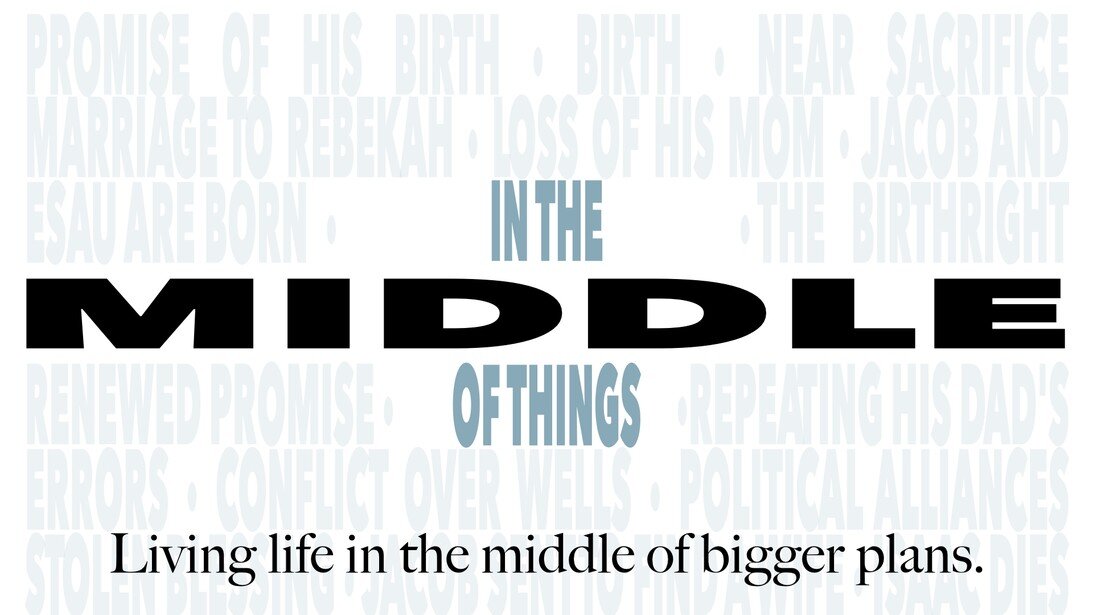
It’s easy to hunker down when life gets complicated. We’ll just manage what’s in front of us and quietly wonder whether God’s bigger plan still has a place for us in it. Genesis 24 takes us to the story of a family facing down that same question.
The following study questions are AI generated and may contain errors.
The pastor uses the story of the Nogales border wall and firefighters as an opening illustration. How does this story connect to Abraham’s challenge in Genesis 24, and what is the sermon suggesting about how we should respond when we encounter obstacles or divisions in fulfilling God’s calling?
The pastor contrasts two approaches to building the transcontinental railroad: the “Big Fill” (filling the valley) versus the “Big Trestle” (building a faster wooden bridge). What does this analogy suggest about the difference between taking shortcuts in our lives versus following God’s intentional plan, even when it seems slower?
Isaac plays a surprisingly passive role for most of Genesis 24, with the action revolving around his servant Eliezer and Rebekah. What does the sermon suggest this reveals about our role in God’s larger plan, and how should this affect our anxiety about not seeing ourselves as the “central character” in our own stories?
The pastor discusses the difficulty of walking backward versus forward in life, suggesting we often try to live looking back at what was easier or better. How does this relate to the Hebrews 11 passage about Abraham not looking back to where he came from, and what are the spiritual dangers the sermon identifies in this backward-looking approach?
Near the end, the pastor uses the analogy of giving medicine to a reluctant pet. What is he suggesting about how we sometimes resist receiving God’s provision or direction, and how does recognizing God’s bigger plan help us accept what He offers even when it doesn’t look like we expected?
This transcript has been automatically generated and may contain errors.
You think so? Maybe not. It’s joyful, but can you imagine, actually, what if I did preach that but just kept playing the whole time, and I’m up here, and he’s going along with it. Would you actually remember anything of the sermon? You’d remember, boy, he’s terrible at that, but would you remember anything? That’s the problem when we’re in the middle of things because you have all that noise coming at you, all that stuff coming at you, and then do we remember where we’re going and why we’re going there, and how God fits into where we’re going? That’s the problem that we face.
As I open tonight, I wanted to share a little something I ran into a few weeks ago. I do so with a little trepidation because we actually have Spanish speakers amongst us in our church family, and I may butcher this, but I believe the town is called Nogales. I think that’s it, Nogales, Arizona, and also the sister city in Mexico, they’re right on the border facing each other. In fact, until 1918, they didn’t even have a border. The main street goes right down the international border, and so it was a big wide street, and just one big town.
Then apparently, there was a battle during the Mexican Revolution, and there was fighting between the United States and Mexico, right there, some skirmishes between the townsfolk on each side, and so what did they do? They built a wall. If you look at pictures of that town today, that really wide street, thankfully it was really wide, because there’s a big old wall that goes right down the middle of it, between the two sides. You have buildings facing the wall on both sides because they used to face each other, historic buildings. Now, they face the wall.
A lot of times, it feels like wherever we’re headed in life, we think we know where we’re going, we can see clearly, and then there’s this wall there, and we lose sight of where God’s leading us, and we think, well, now what am I supposed to do? Well, there’s lots of places where there’s a border wall. Why did I think of Nogales, Arizona, today? Well, the reason was, a picture someone shared, and it was one of those things, it was like this, it was, there’s all kinds of bad news all the time, right? Someone decided to share a set of pictures to encourage you, and one of those pictures, which is owned by a press service, so I can’t share it on our screen tonight, but it was a picture of what happened when Nogales, Arizona got a new fire engine, with a big hooking ladder, I mean, the whole works, really nice one. It’s a town of 20,000, so not a huge town, although it has lots and lots of cross-border traffic and trade, but not a huge town, so I’d imagine the local fire department was probably super excited when suddenly they had this shiny new fire engine.
Well, they hadn’t used it, and then a building on the other side of the border caught fire. Seventy firefighters in Mexico were called to try to extinguish the fire in this historic hotel on the other side of the border wall, and there would be a decision then on what you’re going to do on the American side. Well, what did they do? They pulled out that hooking ladder, went up to the border wall, extended the ladder over the wall, and started, once they made sure everyone was out of the way, started extinguishing the fire with their brand new truck. And they did. It took a while, but they extinguished the fire.
And as I thought about that, for one, it was encouraging, right? Because we get so busy thinking about how people get in our way and difficulties between different countries, right? We’re always in cross-border tensions all around the world. Stop and think for a moment. Here was a local fire department on two sides of the border, and they came together and they worked together over a hundred years after a border wall went up to extinguish a fire. Isn’t that great? Even better, I read afterwards, I looked into the photo, I thought, is this really true? Is this really what it looks like it is? I looked it up. Not only has it happened, it’s happened multiple times. There have been multiple fires on the Mexican side of the border, and I think maybe on the American side, where they’ve crossed the border to help each other extinguish fires. And so, working together despite the obstacles.
Well, in our lives, there are all kinds of obstacles, and a lot of times that kind of puts us into that isolated position where we think, well, I just need, there’s so many obstacles, so many things going wrong. I need to just focus on what I need to do, and sometimes that’s right, right? Because sometimes we’re so focused on what other people need to do, we forget what we need to do. But I just need to focus on what I need to do, and we do that to the extent that there’s a fire across the border, and we don’t help to extinguish it. There’s a neighbor who needs us to show God’s love, and we don’t extend it. There’s a plan that’s bigger than you or me, or all of us in this room, or this church, or everyone that’s online with us. Bigger than all of us, bigger than everyone alive today, and we miss it, because in the middle of everything, I feel like, but I just got this new fire engine, and I don’t want to get it scratched. What if I put it across the border, and someone on the other side bumps into it? And there’s an awful lot of times in my life I think that, and I just don’t put the ladder out then. I kind of pull up tentatively, eh, I don’t know, maybe I won’t do it, right?
As we think about Genesis 24, which is where we’re looking tonight, there are a series of people all around Isaac that have to decide, are they going to stay within their border, stay within their own little isolated part of God’s plan, and just hunker down, or are they going to see the bigger plan? And as we think about that, I think it’s challenging all of us, because God’s plan hasn’t contracted. It’s bigger than ever. Well, really, it’s always been that big, but we can see how much bigger it is. And are we going to see the big, big, big plan of God? Are we going to pop the walls and say, I’m just going to hunker down because I don’t know what will happen if I do? Let’s pray that God can help us to see that plan, and how He’s working in our lives through it.
Father, would you guide us to be prepared to do what you have called us to do? Sometimes that’s just doing the next thing, putting one foot in front of the other, and just doing what you’ve called us to do, but a lot of times that’s in coordination with all kinds of other moving parts all around the world. People around us here at church, the people in our community, the people in our nation, the people in our world, would you help us to keep that bigger plan in mind that we would be ready to serve, ready to answer your call, even when in the moment it’s a little hard for us to see? We pray in Jesus’ name, amen.
We do lose sight of God’s plan a lot of times. I lose sight of God’s plan a lot of times. I get up here, and I talk about God’s plan, and how everything’s working, and then I lose sight of it. But God works in all the pieces I can’t see, all the pieces you can’t see, and He gives us His word so that when we can’t see that, when we’re Thomas, and we’re hearing about what’s happened to Jesus, but we didn’t get to see it ourselves, we can hold on and be amongst those that follow where God’s calling us.
Let’s take a look at verses 1 to 4 of Genesis 24. It says, Now Abraham was old, well advanced in years, and the Lord had blessed Abraham in all things. And Abraham said to his servant, the oldest of his household who had put charge of all that he had, Put your hand under my thigh, that I may make you swear by the Lord, the God of heaven, the God of earth, that you will not take a wife for my son from the daughters of the Canaanites among whom I dwell, but you will go to my country and to my kindred and take a wife for my son Isaac.
What’s going on here? Well, Abraham is a powerful, important man. He has lots of servants, lots of people tending to his livestock and to his household. And in the midst of all of that, we probably have here, we’re not told the name of the servant, but it’s quite possibly Eliezer, whom we encountered back earlier in the book of Genesis. Someone who’s been with Abraham for quite a long time. So faithful to Abraham, in fact, that when Abraham had no descendants, that the plan was if he died, everything goes to Eliezer. It’s probably that man.
And so here we have a longtime servant of Abraham, and Abraham realistically looks at himself. He’s getting older here. He’s probably about 139 at this point, somewhere in there. That’s getting up there, right, a little bit. He qualified for his AARP card a while ago. He gets a discount when he goes to the movie theater and has for as long as he can remember. It’s getting up there. He looks at what God’s called him to do. He’s called him to this place. This is where you’re supposed to be, Abraham. And we’re going to develop out of you a great nation. Through Isaac, there’s going to be a nation that blesses the whole world. He knows all that, but he says, there’s a problem here.
In the midst of all of that, there’s a lot of unbelieving people around here, a lot of people who don’t know the Lord, have no interest in knowing the Lord, and then there’s us. We’re right here. And Isaac needs a wife, and if nothing is done intentionally, he’s going to marry someone in this land. Logically enough, if he’s not going to move, what’s he going to do? Well, he’s going to marry someone here. And if he marries someone here, what happens? I want someone who’s going to carry on the promise with him. God’s plan is bigger than us, and I think we see that in Abraham’s recognition here of what needs to be done for Isaac.
Because what Abraham’s saying as he makes his servant swear, and it sounds sort of bizarre to us, but he says, put your hand under my thigh. That’s a custom in that land at that time to symbolize, sort of like maybe we’d say, I’m going to put my hand on the Bible right before I go into court. It’s sort of similar. They didn’t have a Bible they could put their hand on at the time, but it’s what they would do in that culture at that time to say, this is really, really, really serious, and I want you to promise me that you’re going to see this through, because I want to know that my son marries someone that is part of my people, someone who won’t hinder the mission the Lord’s given, but encourage the mission the Lord’s given.
And so Eleazar, if it is in fact him, again, it doesn’t say, but I tend to think it is that man, is going to go off, and we’re not going to read all of it. We don’t have time to read the whole chapter tonight, but if we were to go off through the rest of chapter 24, what we see is that he goes off, and if you know this story, it’s a wonderful story. He goes off to Abraham’s ancestral land, and what does he do? He sits down at a well. He sits down at that well, and he prays to the Lord. He prays that God would make it clear to him whom it is that Isaac should marry.
Imagine here you are, the faithful servant to Abraham. You’ve been faithful to him all your life, sought to serve with integrity, and now you’ve been tasked with making sure the mission that your master has spent his whole life on is going to be carried into the next generation successfully. We see in the rest of Scripture why this is so important, right? Because time and again what happens, the people intermarry with the peoples around them that don’t worship the Lord, and they quit following the Lord. They quit following the Lord. We see this today. Statistically, we were talking about this in Bible study a few weeks ago, statistically, sadly, it’s not mechanical, it doesn’t have to happen, but certainly more often than not households that discard the importance of sharing a faith in the Lord, the children discard faith in the Lord.
Abraham’s a smart man. He can see this coming, and he says, I don’t want this to happen, so he sends Eleazar, so all this is resting on Eleazar because he’s a smart man as well. He knows what’s at stake here, and he says, this is too much for me. I need to trust in the Lord that God is somehow going to pull everything together so that Isaac has the right wife, someone who can continue this mission, and so he asks that God would reveal the right woman to him and that not only would someone walk up to him, he wants to make sure by seeing a demonstration of hospitality that he’s found the right woman, someone who will not only see him there and maybe take concern over him and his need for a drink, but also for the camels that have come with him, and what happens? Rebecca walks up, she offers him a drink, waters his camels, and the man rejoices.
Now, wouldn’t it be nice if everything that we need to do, every major life decision, every time that we were trying to decide where does God want me to live, trying to decide whom does God want you to marry, whom is that, or where should I go to school, or should I change jobs, you just say, well, you know, I’m thinking about a new job, and so God, if I walk into this place of business and the owner of the business walks out and offers a drink to me and offers to take a gallon of gasoline out to my car, I will know that you want me to work here. Doesn’t work that way usually, does it? Certainly there’s something special here, but in the specialness of what God is doing here, there’s also something that’s incredibly ordinary, which is that Eliezer recognizes that God’s providential care, his care for his people, his continued care, is at work. He can have confidence that if God promised to Abraham, I have this promise, and I’m going to bring this promise to bear through Isaac, and that in the generations to come, the descendants of Isaac are going to be more numerous in the seashore, and there’s going to be this great nation, and through this nation, the entirety of the world is going to be blessed, that if God has said that his care is continuing to work, and I think in the midst of all the specialness of this miraculous revealing of Rebecca, that basic truth that when God gives a promise, he gives the care to see that promise through, is something that we really should put our focus on, because we say, well, it’s all nice and good. If only God worked that way in our time today, it would be wonderful, because I don’t know what I’m doing, but if God would do that kind of thing for me, I would know exactly how to do everything I need to do. Everything would be great. I’m just stuck in the middle like Isaac. I have no idea what’s going on.
Notably, in some sense, this story is all about Isaac, but right now, he has nothing to do with it. Kind of interesting, isn’t it? A lot of times we feel like in our own story, I feel like everything around me is moving. I don’t feel like I have anything to do with it, and I have no idea how God’s plan is working, but here is the servant of Abraham who, in the midst of that story, and in the midst of his own uncertainty, because keep in mind here, here is a man who, at one point, was supposed to inherit everything Abraham had. If Abraham had never had a child, and for a long time it looked like he wasn’t going to, he was going to get everything.
Now, not only is he not going to get everything, he’s helping to make sure the line perpetuates that gets all the stuff he was supposed to get. But despite that, he looks at the situation and says, I believe God’s working, and I’m so confident in that, I’m going to ask this specific request. I have confidence that God’s going to work in it.
Now, again, this is not encouraging us to ask for special signs from the Lord. There’s certain parts of the church today they’ll talk about laying out the fleece, from another story, from Gideon’s story, and make a big deal out of that. There’s nothing to encourage us, in scripture, to constantly test God and his will. He’s given us his word. He’s made clear the very core overarching path that he wants us on. In here, we can look in here. It may not answer the specifics in every moment, but he’s given us the overall picture. But it is calling us to have confidence that he is going to work, that he really is going to work.
As he’s promised to be faithful to you, he’s promised to be faithful to me, but guess what? He really is faithful.
How often do we think, as we look at the bigger picture, and we realize, like Abraham, Abraham’s not going to get everything, he’s not going to get everything, he’s not going to get … And we realize, like Abraham, Abraham’s looking out and saying, okay, there is this wonderful, spectacular promise, but you know what? It’s going to go on without me.
And how often, when the promise is going to go on without us, do we start to wonder if it’s really a promise at all? But God’s plan is bigger than any one of us. And if we understand that and we hold on to that, then when the plan is moving along full steam ahead, and we’re not seeing ourselves as the central character, it doesn’t mean that we should start to assume that it’s not really going to happen. That maybe, just maybe, we’re playing a part in that story. In fact, we are. Every single one of you is going to play a part in the story that God has laid out for us. But maybe, just maybe, we’re not going to see all the pieces come together right now, or even in our lifetime. That doesn’t mean the story isn’t carried on. And that’s what’s so important here.
Here are two people who are not going to see the full fulfillment of the story, neither of them. And in fact, the next generation along with them is not going to see the full story fulfilled. But, but, they are going to see the full story. To see God continue to move. And that’s what we have the opportunity to do as well.
When it feels a little uncertain though on exactly how God is doing that, and how it’s all coming together, I think one of the big challenges is that we start to wonder though, am I even headed in the right direction? And that’s where it’d be really nice if we could ask for the sort of sign we see here, something that just clearly says, this is exactly how it works. This is how all the pieces come together.
I think where we get ourselves in the most trouble though, is when we’re so focused on specifics, we say, well then I can’t know any, I have no idea where I’m going. I have no idea how I fit into God’s bigger story. And yet again, right here, we have our answer. Because you see, while we may not know the specifics, should I take this job? Should I marry this person? Should I move to this town or that town? Should I become an international missionary? Or should I just stay right where I am? Should I have a hamburger for dinner? Or should I have a pizza? There’s all kinds of questions we’re confronted with. And some of them big, some of them small, some of them consequential, some of them inconsequential. And we love the details. But while we’re fretting about all those, God says very clearly what we’re supposed to be doing in the main.
And the thing I think we should ask ourselves is, okay, I’m trying to figure out exactly how all these pieces fit together. But with the pieces I have right now and the direction I’m headed right now, am I aligning myself with where God’s called me to be? Because sure, there’s other things I’d like to have come true. There’s other things I’d like to see fulfilled. And I’m not even necessarily always sure exactly how it’s going to happen in the moment, but I can be confident that if I’m following the map that God’s provided, if I’m living in the way that God’s asked me to live, if I’m doing the things that God’s asked me to do, if I’m being faithful to what God has given me in this moment, then, being faithful to what God has given me in this moment, then I’m being aligned to that bigger story.
And I might not know exactly how all the alignment happens, but it’s going to happen.
I think about aligning plans, and as I was trying to figure out where we should exactly go in this text and praying over it and thinking, God, what do you want us to focus on in this text? I started to think about just how many pieces have to come together for this chapter to happen as it does. And it made me think of various big plans over the course of history that have had a bunch of different parts that had to come together to work. And one of those, one that sort of boggles my mind anytime I think about it, is the transcontinental railway.
They say railways, they’re so outdated. That was so 19th century. Why are you talking about railways, Tim? Well, think about the transcontinental railway for a moment.
Prior to the building of the transcontinental… Let’s see if I can just get the words to join together. Prior to the transcontinental railway, it cost the equivalent today of approximately $10,000 to travel from one end of the United States to the other, and you might not survive it. On the other hand, when they built the railway, it brought it down to approximately $100 today. And you would almost certainly survive it because you went from… Many of us have played the Oregon Trail. You went from getting various illnesses and dying somewhere out in the middle of Wyoming or something, and your party has to move on, and then they get their wagon wheel breaks, and their ferry sinks, and they’re dead. They all die, and you see the little tombstone, and the game ends, right? You go from that kind of travel to what? Hopping on a train, eating good food, visiting with people, and arriving at most in a week on the other side of the country.
Today, even that doesn’t sound that amazing because you can hop in an airplane and be there in a couple hours, but if you imagine going from, I want to travel to California, and maybe someday I will survive to see my family back here in St. Louis again, maybe, to, yeah, I can get there in a couple weeks, back and forth, no problem. That was revolutionary. But to do it, you had to build the track, right? You have to build thousands of miles of track. You have to go through mountains. You have to build tunnels. You have to do all this stuff, and so they went, and they started building this, and they did it in a way that they thought would get it done as quickly as possible.
Congress passed a bill that would allow two different railroads to start building from opposite ends towards each other with the idea that they would race to see who could build the most track to get it done as quickly as possible, and so the Union Pacific and Central Pacific start building these railroads, and one thing Congress didn’t think about is, well, what if they don’t agree on where they should meet? It’s kind of interesting.
At one point, they knew they were getting close to each other, but they wanted to get the most track laid. They wanted to be the one who dominated and got the most money, and so they arrived at this one point in the mountains, and right here you have what’s called the Big Fill. The one railroad said, you need to get across this big valley. What we need to do is just fill it up. That way it’s nice and secure. But they got there first, and it takes a long time to get that much fill in a place. So if you look in the background of that picture, you can see sort of a cutoff where a bridge could have gone. In fact, the other railroad, they knew that this one, their competitor, was already building that giant fill dirt bridge, as it were.
They built a wooden trestle bridge because they said, well, we can do that faster. Maybe we can get over first and claim that we’re the one that went the farthest. There was the big trestle. So the Big Fill versus the big trestle right next to each other. And in fact, at first, the big trestle won out because it got done faster. You can put a bunch of boards together faster than you can fill a valley with dirt, even with modern equipment, much less with ancient, not ancient, but historic equipment.
And so then Congress had to help negotiate out where they were actually going to meet because they just kept passing each other. They just kept building. And for example, you can look even on a map today. Here’s a satellite map, and it’s kind of interesting if you look there. Let’s see, my pointer doesn’t really show up on the screen. But you can see down towards the bottom a track that isn’t really a track anymore, but the scar on the earth where the one railroad went, while the other one was building just a few miles up, going approximately the same path.
You know, a lot of times when God is calling us someplace, we’re sort of like those railroads. We see where God wants us, but we think we can get there faster. We think that we can get there more efficiently, more pleasantly. We can enrich ourselves a little bit more. And so we say, well, God said to fill the valley, but I can build a trestle faster. And when we’re only thinking about how I get from point A to point B, and we’re not thinking about the bigger plan and all the things that God’s doing, it makes sense because if the only point is, how do I get to where I need to be? If the only point was, how does Abraham get to be a leader of a nation? Well, that would have made sense. He would have taken his household, mounted a giant army and conquered someplace.
The slow way to build a nation is to pass down the promise from generation to generation until there’s a nation. That’s the really slow way. But that was God’s way. And as Abraham sends his servant off, he says, well, let’s not build a trestle. I want to make sure that we’re filling the valley. Because here’s the interesting thing about that trestle versus the valley. They closed the trestle relatively quickly because it wasn’t stable. And even if they’d kept it open, it wouldn’t still be there today. It was wood, it would rot away.
But even the better part of a century since they rerouted the track entirely and that big fill is no longer used either for the track, it’s still there because they built it to last.
And when God calls us to act in the ways that are pleasing to him, when God calls us to follow what he’s mapped out here, he isn’t leaving us like an act of Congress to wonder, I wonder how we get this all to connect. He’s given us what we’re supposed to do. We know which valleys we need to fill and which tunnels we need to bore. Just a question, do I want to go that way? A lot of times I go ahead and build the trestles. A lot of times they start rotting right away.
I want to know what God’s plan is for me. That’s what those railroads want. Well, where am I supposed to be? And if it’s up to me, I’m going to put myself wherever is going to get me the furthest. And what God wants is for us to say, well, where am I actually supposed to be?
There were something like, as I understand, 200 miles of at least partially constructed track that never got used because the two railroads didn’t worry about where they were actually supposed to be. And there’s an awful lot of track in our lives that we build. We’re going in the right direction. It’s not that we’re seeking to do things that aren’t what we’re ultimately supposed to do necessarily. But in doing that, we build an awful lot of track in the wrong direction.
Can we reset by recognizing the plan’s bigger than us? So if we just focus on how God is saying to proceed, then we can get to where God wants us to be. Sometimes we know what the ultimate goal is, we know that it’s to meet the two railroads so you could travel across the country rapidly. Sometimes it doesn’t seem that clear. And each of us is going to do some things in our life that God’s going to use in the next generation or the generation after, or the generation after that, or five generations after that, that we don’t understand what the impact is going to be.
But if we know what God wants out of us, and he’s very clear on that, then even as we’re trying to sort out the rest, we just keep moving faithfully.
Now, that’s easier to say than to do.
But the problem for us oftentimes is not attempting and failing, it’s not attempting.
Where is it today that we’re not attempting? Where is it today that I’m not attempting? And you’re not attempting. Sometimes it’s because we might fail.
Why did the one railroad decide to build the wooden trestle bridge even though it was clearly inferior? Because they thought they attempted to build a fill land bridge that would last, and last, and last, they might fail to get to the goal that they wanted. And I think that an awful lot of the time when we fail as Christians, it’s because we’re not sure we’re going to get to the goal that we want.
How did Abraham hold on? How did Eliezer hold on when it looked like the goals were going up in thin air? Abraham says, I’m getting old. I’m tired of signing up for new AARP cards, and I still don’t have a nation. Eliezer said, I had a giant inheritance, and my master, he just keeps living, so I’ve lost that, and now I’m losing it to the sun. Now, I’m helping to make sure there’s another generation after that. It doesn’t matter if I live for 500 years, I’m never going to get anything. How did they hold on?
And those very human questions that float through our head that make us wonder how it’s working out for us.
Hebrews 11 tells us, these all died in faith, not having received the things promised, but having seen them and greeted them from afar and having acknowledged that they were strangers and exiles on the earth. For people who speak thus make it clear that they are seeking a homeland. If they had been thinking of that land from which they had gone out, they would have had opportunity to return. But as it is, they desire a better country that is a heavenly one. Therefore, God is not ashamed to be called their God, for he has prepared for them a city.
Sometimes it’s not that we’re expanding into the wilderness like those railroads and going further. We’re looking and saying, well, God seemed to send me this way. And I know that God wanted me to go this way, but this way is hard. Maybe I could just turn around. The Israelites thought this, right? They left Egypt and said, we didn’t like Egypt, but this is harder. And a lot of times if we set out on the Christian life and say, God, use me and send me and help me to complete the mission that you want for my life, we’re going to be awfully tempted to say, is it too late to hit the undo button and go back? Because this is really, really, really, really hard.
But the author of Hebrews tells us that what happened for Abraham and for Isaac, what happened for each person that’s walked in faith, what did they do? They didn’t look back to where they’d come from. They were looking to where God was calling them to. And I’ll admit, this is something that’s hard for me to do a lot of times, a lot of times. I’m not saying I had this all figured out, but I do know that God is saying what works. Because if Abraham had looked at all the challenges he faced, all the doubts and struggles and uncertainties, now he’s dying in a foreign land that wasn’t his own with a promise that someday it will be his descendants, but not his. It’d be awfully easy to think, but what about when I was back home? I had all kinds of family there. I have all of my favorite spots I grew up around. I kind of like to go back. I’m not going to live to see the promise. I’d like to go back.
But Abraham didn’t. He saw where God was calling him. And so here at this point, at this crucial juncture in his life as he grows old, what does he do? He, instead of thinking about how to save his own skin or make sure everything works out for himself, he’s worried about how do I pass the torch on? And so you make sure that Isaac is going to have a wife that’s going to help carry out the mission when Abraham isn’t there to help carry out the mission.
Now, like I said, I’m pretty good at looking backwards, but I’m not very good at walking backwards. For some of you where college is in the rearview mirror, you may remember some time ago or a long time ago, a time when you went to a school and it’s somehow required if you’re the student that’s going to give the tours, you have to walk backwards while talking to the potential students and the parents. I remember this going, I was fascinated when I was in high school and going to different college campuses. There was always a college student that gave the tour. All the families are there. You’re walking down and that person is walking backwards, talking about, oh, here’s this and here’s that hall and here’s where you can do this, right? And I can’t even walk this far without running into something. I can’t do it. And I remember when I was teaching at Lindenwood and occasionally there would be a student, I had a potential student I’d give a tour to and I’d do that for about five steps, right? Nope, nope, we’re gonna, I’m just gonna walk straight ahead. I couldn’t do it.
Now, an awful lot of us, in fact, all of us, when we’re talking about living our lives, not physically walking backwards, but living in the calling that God’s given us, we try to live the calling that God’s given us walking backwards. And we can’t do it. We fall over stuff. Now, I’m not saying we don’t reflect on how God has worked powerfully. I’m not saying we don’t appreciate what’s come before. But if we spend all our time thinking about, wistfully about how things were better before or how things were easier before or what if I could somehow redo things in a different way, we’re not going to be walking the way that God wants us to. We’re going to stumble. We’re going to fall.
But if we say, well, I’m not really sure why God has me here because I’m not really even sure where I am. But here’s what I know. God has a bigger plan and I’m walking according to where God’s called me to in this particular moment. And so therefore, I know that I can keep walking. Well, then what happens? Not only do we realize, well, God’s doing this plan around us, right? Isaac, Isaac’s passive in this story thus far. Story’s happening around him. Story’s often happening around us. But as we see that story happening around us and we wonder what God, if he even cares about us, what do we see as we go to the end of the chapter?
Well, God cares to bring us into that story. As we seek to do it, we seek knowing that he remembers us and he’s involving us. Verse 62: Now Isaac had returned from Beerlehairoi and was dwelling in the Negev. And Isaac went out to meditate in the field toward evening. He lifted his eyes and he saw, and behold, there were camels coming. And Rebekah lifted up her eyes, and when she saw Isaac, she dismounted the camel, and said to the servant, who is that man walking in the field to meet us? The servant said, it is my master. And so she took her veil and covered herself. And the servant told Isaac all the things that he had done. And Isaac brought her into the tent of Sarah, his mother, and took Rebekah. She became his wife and he loved her. So Isaac was comforted after his mother’s death.
Isaac was in the tent of Sarah, his mother, Rebekah, his feet. And for his mother she lied on the ground on the altar, her defects, and standing under her altar all the time. This is so important that we take a seeded breath of 30 minutes and draw a long drawing of Isaac. Isaac only shows up at the end of this particular story in his life. Kind of crucial, don’t you think? He’s gonna get married. Sounds sort of like what we encounter later on in Jacob’s life. You kind of wonder if Rebekah ever would have ended up back there, ever would have ended up marrying Isaac. Except the servant says, no, I need to complete this mission. And the family of Rebekah says, okay, Rebekah, would you like to go now or would you like to not? She says she’ll go.
She doesn’t know where she’s going necessarily. She’s never met this man before. But she says, okay, something’s happening here. God’s working. I’m going to go and I’m going to do it. Abraham trusts without seeing the result. The servant trusts without being able to see the result first. And Rebekah does. And in that, then you start to see how the plan’s going to come back to the man that we’re ostensibly focusing on in this series, Isaac, who oftentimes just has things happening around him.
All these people are acting faithfully. And it’s all part of the story of Isaac as well. And a lot of times when we see other people acting faithfully, we think, well, if only I could have faith like this person or that person, if I could be like her and just pray so constantly, if I could go and go on the mission field like him and just go and do it, I would be, now then I would be a real Christian. But I’m not like that.
A lot of times what we don’t see as well, but there’s a giant tapestry that’s going to include us that’s right there in the midst of this. The fact that Isaac isn’t in the story as Rebekah comes to that, well, it doesn’t mean that Isaac isn’t in the story. Part of the confidence in believing that God has this bigger story that’s bigger than us, that has all these pieces coming together, is that wherever you are today, whether you feel like you’re in complete control and you’re cruising along exactly where you think God wants you, or you’re saying, I got on this roller coaster thinking it was just a tram around the park and I have no idea what’s happening next. I really wish I weren’t about to experience it.
Wherever you might be. If we truly believe what we see in God’s word, the thing that we can know is that God is going to bring it all together. He hasn’t forgotten us.
So what do we see here? Isaac, I believe in this one thing that he does shows that he believes that.
When he sees Rebekah coming, he doesn’t question it. I believe that Abraham is still alive at this point. Some people have suggested if we kind of refigure things a little bit, maybe Abraham has passed during this journey. I think Abraham’s alive, but in any case, he’s not here at this moment. Isaac doesn’t say, well, I’m going to go talk to my dad and say, I don’t know my cousins. I really don’t know if Rebekah is someone I should marry. I don’t know, but no. What does Isaac do? He says, this is clearly God’s plan. So what does he do? He takes Rebekah as his wife.
And in that, the promise continues. Because at this point, Sarah died. She’s no longer part of the story. The second part of that promise that’s been going on for the first part of Genesis, Abraham and Sarah, she’s no longer in the picture. And what does, what symbolically happens here? Well, Rebekah takes her tent. She’s going to carry on the torch for Sarah. She’s going to carry on into the next generation. The torch of this promise.
And in that, we see all these different parts, all these different people, all completing their own part of the story, their own part of the promise without the overall promise being there. And because they’re willing to act faithfully, believing in their part that God is working in the bigger picture, as they’re willing to receive what God’s doing, even as he’s been working outside of their lives, what do they do? They get to see God bring it all together.
A lot of times it’s so much bigger than us, but it’s not less than us either. God includes us in that story.
I was thinking about if any of you, do any of you have a dog or a cat? We have some, not as many, well, some grand dogs in here too, I know, at least. Have you ever had to give a pill to a dog or a cat? Do you just open the pill jar and say, let’s see, it says take one, okay, fluffy, here. Does that work? Does it ever work? I don’t think so. What do you do? You wrap it, yeah, you chase them first, and then you wrap it in something, and then you still probably chase them because they say, well, I know what’s in there. You’re not fooling them, right? Especially after the first pill.
But we have to coax them into taking it. And why are we giving them the pills? Well, because they have heartworm or something, right? Something serious. Something that would be bad if it weren’t treated. It’s fine if it is treated. The pill isn’t even that bad, but that animal does not want it because it’s something that seems bad in the moment. It doesn’t seem to go according to his or her plans. Treat, sure, let’s talk. But pill, no thank you.
And yet, and yet, for fulfilling that animal’s life calling, it’s necessary. And a lot of times when God’s been working all around me, and I’m thinking, well, does God’s plan include me? Things start coming towards me. Things start to come together. And I think, but I don’t know if I want to receive it because I’m not sure it looks as good as I thought. I’m not sure it looks as smooth as I thought. It looks like God’s trying to feed me a giant pill, and I don’t want to take it. And I know that he put some cheese around it, but I still don’t want to take it. And then he wrapped some bacon around it, but I still don’t want to take it because it looks like a pill in there.
But as we take those pills, because we are confident that the bigger plan is a plan where God doesn’t just discard us, that God loves us, God is going to work in us and through us. We may not see the overall promise come to fruition. We may not see on this earth the day that Jesus returns. He will return. It may not be in our lifetime. But God’s going to use us as part of furthering his kingdom to that day.
Where am I not willing at this moment to receive how God is working? It’s a question I kept asking myself over the last few days working through this passage. Because a lot of times I back away from those pills. Anyone else that way, where you just keep wanting to back away? But in the middle of everything, it’s all chaotically going on, and we think, well, there’s no way that God remembers me. I want to do a Sinatra. I’m going to do this my way. God’s calling us to do it his way. And his way because his plan hasn’t forgotten us.
In the middle of everything, if we can be aware of the bigger picture, we are aware of a picture in which God cares for you and cares for me, and it’s going to bring us all into that bigger, more beautiful, more amazing, and we can possibly imagine, story of the kingdom of God.
And we pray that as individuals in the church, that we would be ready for that even today.
Let’s pray.
Father, so often it seems like we look at the story, and we look at how you’re working, and we think that looks really wonderful. That looks really good. It looks like something for somebody else. I don’t, it seems like there’s this bigger story. I’m just stuck in the middle of it. Like Isaac, everything’s buzzing around. Pieces are coming into place. But the only time it ever seems to come to me, I’m not even sure I want to be a part of what’s happening in this moment. But Lord, would you give us the confidence to trust when we can’t see how it works out well? Would you give us the confidence to pursue your calling in the way that you’ve called us to? To fill the valley with dirt when we’d rather build a trestle. So that we might get to exactly where you want us to be. That we could fulfill our part of the story. Big, small as it may be. Knowing that the ultimate story, the story of your mercy and your love for each and every one of us will be fulfilled. And just as Abraham and Isaac and all the others look to that promise, to that hope, to that heavenly city that we might too. And as we do, we know that you will be with us. And we pray this in the precious name of Jesus. Amen.
Start the Conversation