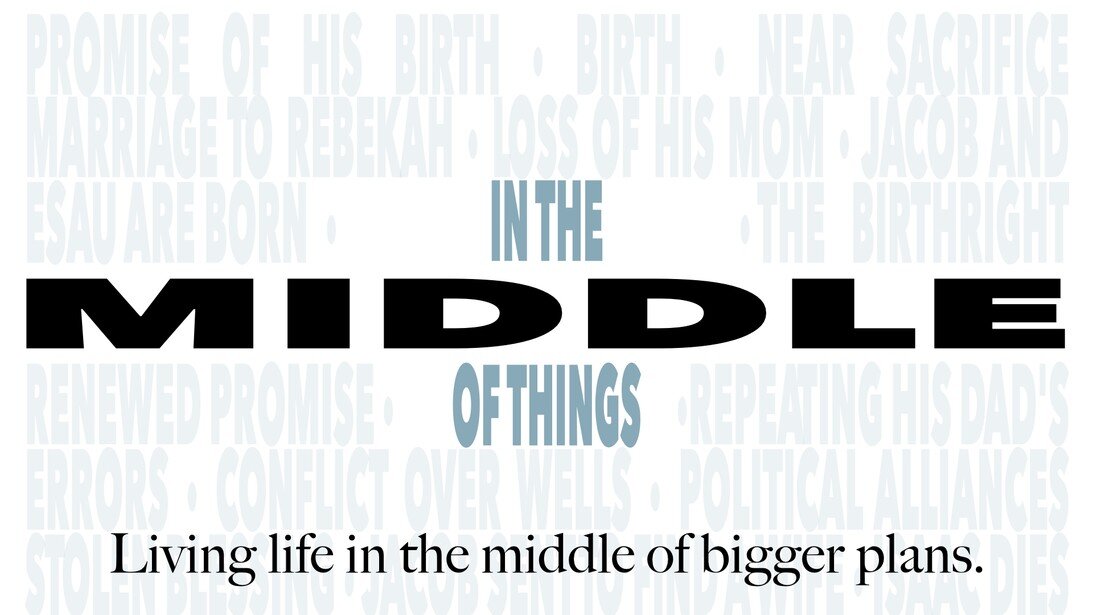
God told Rebekah before her sons were born that the older would serve the younger—yet in Genesis 25, Isaac loves Esau most. Nothing looks like it’s heading where God said it would. When the path to God’s promises feels unnecessarily tangled, can we still believe he’s working?
The following study questions are AI generated and may contain errors.
The pastor uses the Rube Goldberg machine as a metaphor for how God’s plans can seem unnecessarily complicated from our human perspective. Can you think of a time in your own life when what seemed like a confusing, indirect path later made sense? How does this metaphor change the way you view current uncertainties?
Isaac is described as a passive observer in the unfolding story of his sons, unable to control the outcome despite his preferences. How does this relate to our own experiences of trying to control situations or people? What does it mean to trust God’s plan when we can’t see the full picture?
The sermon uses the image of sailing in a straight line on a globe—what looks curved and wrong from our limited perspective is actually the correct course. When have you tried to “course-correct” God’s path in your life, and what was the result?
The sermon contrasts Jacob, who saw value in the birthright, with Esau, who despised it for a bowl of stew. Where might we be tempted to undervalue God’s long-term promises for immediate gratification, and how does fixing our eyes on Jesus help us resist that?
Joseph’s declaration that “you meant it for evil, but God meant it for good” is presented as a key to understanding Genesis. How does recognizing that our sins and misdirections do not hinder God’s ultimate purposes bring hope and perseverance in current struggles?
This transcript has been automatically generated and may contain errors.
God’s Word tonight.
You know, sometimes in the absurdity of life, we just can’t help but smile, right? Maybe a smile or cry, but I guess that’s something, right? Sometimes things just seem ridiculous and counterproductive, and we wonder where we’re going. I think one of the reasons why I resonate so much with Isaac is because you see some parts of scripture, right? You read some of the stories, and maybe even, well, let’s just look at Isaac’s dad for a moment. And ironically, we’ve probably been talking about Abraham as much as Isaac in the story of Isaac, because Isaac is just stuck in the middle of everything.
But you look at Abraham, and yeah, he had some indirection. Yes, he had times of waiting, but most of the indirection was his own doing, right? He would start doubting what God was doing, and something would happen. He would doubt and fear for his own life, and something would happen. Isaac oftentimes seems more like an observer, and I think sometimes we feel like that, right? We set out. We’re going wherever it is that we feel like God has called us in this moment, and we’re going along, and we feel like we have this all worked out, and then it doesn’t quite go according to plan. Why doesn’t God just make everything straightforward?
Sometimes, does anyone know here what a Rube Goldberg machine is? Hey, we have some Rube Goldberg fans here. Would someone like to tell, what is a Rube Goldberg machine? Anyone want to be put on the spot? What’s a Rube Goldberg machine? It’s something that has a part that does something else, and usually many parts, right? Very good. Let’s go ahead and take a look at one, for example. Here is a self-operating napkin. Haven’t you always wanted one of these? You’re too busy eating to wipe your face, so why not just build a machine that sits on your head? That looks comfortable.
I thought, well, maybe we could just do this together. Let’s figure out how this thing works. Let’s see. A is his hand, so we see his hands tied to a string, and then that string goes up here to a pulley, to a spoon, C, that’s going to toss a cracker, D, to E, Polly, the parrot. Polly’s going to lean over to grab the cracker, which is going to pour the water into the bucket, H. This guy’s going to have a headache by the time this is done, isn’t he? H, which pulls the string, I, which goes over to the lighter, J, which lights the rocket, K, which then cuts the string, M, and let’s see, L, and then what do you know? When it cuts it, we have the clock there that’s ticking back and forth, the napkin now moves into position over the man’s mouth, and all is good.
He doesn’t have to do anything in order to eat his soup. Makes sense, right? Anyone going to get a self-operating napkin like that? You go home and make one? We have one self-operating napkin user here, but most of us probably won’t, and most of us would probably think, by the time the rocket sparks have scorched my face and the bomb’s bursting in air, I would say, can you see? The parrot’s squawking, and then you take another bite of soup and there’s no more crackers to give to Polly, and so on and so forth.
Why can’t we just pick up a napkin and, hmm, that sounds easier, but doesn’t it often feel like we’re living a Rube Goldberg? Get one thing in order, and it launches something else, and it launches something else, and it launches something else, and it seems like, well, if God really wants me to wipe my mouth after I take a bite of soup, why don’t I just pick up a napkin and wipe? Why do I have to go through all these things? And sometimes it’s really that simple. Sometimes it’s just a matter of saying, oh, okay, well, maybe I should just listen more to what God wants me to do.
But aren’t there a lot of times you sort of feel like there’s no direction? You’re trying to get there, but all you can see is that the parrot’s squawking and the rocket’s taking off, and you think, I’m watching this thing, but I don’t really know where you’re leading me on.
Let’s take a look at verses 27 and 28 of Genesis chapter 25. It says, when the boys grew up, Esau was a skillful hunter, a man of the field, while Jacob was a quiet man dwelling in tents. Isaac loved Esau because he ate of his game, but Rebekah loved Jacob. So we have a bit of a conflict here in affection for the sons. It also seems to run afoul of what we were told earlier that we looked at last week, that the younger would be the one who was key to the promise, the older is going to serve the younger. It seems like what’s going on here? Esau is loved by Isaac. What’s going on? And I kind of wonder if maybe Isaac wondered a little bit about that.
His wife is favoring Jacob, trying to get advantages for him, but Isaac’s saying, but I love Esau, I think he’s the one, he has it all together, he’s a hunter, he goes and brings in fresh game, he’s a son. And there’s been this hint of conflict for the entire lives of Esau and Jacob. And here, once again, Isaac is the observer. You know, God, if you want to keep this promise going, why can’t it just be clear and straightforward? If you wanted a son of mine to carry for that promise, couldn’t he just have been born clearly as the heir of the promise? Why does it have to be complicated? And yet God works in that complication.
And let’s pray as we face our own challenges and complications in life, that God would show us how he’s working in them. Father, we come before you as those who want to do your will. Everyone here, everyone online, however we’re gathering together tonight, Lord, we want to do your will. If we’re here tonight, we want to hear your word. That’s what we’re doing, and yet, it’s so hard sometimes, because we just don’t understand. We feel so complicated, unnecessarily complicated. We think, well, if only we were planning out, we could think of different ways to do it. But Lord, we know you’re faithful, and so would you help us to see out the things that you’ve called us to do, and to stay faithful in the process of pursuing them. We pray in Jesus’ name, amen.
So Jacob and Esau, grown up, so we cut a lot of time here, right? We’ve moved a good bit of time. They’ve grown up. And now the question is, how’s this going to play out for carrying the promise to the next generation? Let’s take a look at verse 27. It says, when the boys grew up, Esau was a skillful hunter. We saw that. A man of the field. Well, Jacob was quiet, a quiet man dwelling in tents. Isaac loved Esau because he ate game, but Rebekah loved Jacob. And now, know how this is playing out.
Once when Jacob was cooking stew, Esau came in from the field, and he was exhausted. And Esau said to Jacob, let me eat some of that red stew, for I am exhausted. Therefore, his name was called Edom. Jacob said, sell me your birthright now. Esau said, I’m about to die of what use is a birthright to me? Jacob said, swear to me now. So he swore to him and sold his birthright to Jacob. Then Jacob gave Esau bread and lentil stew, and he ate and drank and rose and went his way. Thus, Esau despised his birthright.
Not going on in there, but if you’ve never read the story before, it wouldn’t necessarily be the way you’d expect it to go. Isaac favored Esau. Esau looks like this man of the land, a manly man. He’s off hunting and gathering and being all impressive. And Jacob is more of a city slicker. He dwells in tents. Now, I don’t want to play this up too much. More than likely, what we’re really seeing here is a description. Jacob is a shepherd. So if your choices are, which aren’t our choice today, but if your choices are out hunting wild game, hunter-gatherer style, or raising domestic animals, Jacob is the one who isn’t as impressive from an outdoorsman type. I mean, today, for most of us who live in cities and don’t work the fields and so on, if you read about a farmer, we think, wow, there’s someone out working in the land and so on. But at this time period, Jacob is the one who’s sort of like, we might think of as, say, an office worker. He’s not going to be as impressive when he shows up on television talking about everything he’s done, right? Because he hasn’t gone, I mean, you don’t turn on National Geographic channel to watch the jungle of cubicles. You turn it on to see what? To see someone out on a safari hunting wild game or something.
And Isaac finds this appealing about Esau. Not only does he find it amazing and impressive that Esau’s out doing this, he finds it impressive that Esau brings home that game and he gets to eat it. Because Isaac clearly would rather have wild game than domesticated animals. Jacob can raise his livestock, and maybe some of those are going into the food they eat oftentimes. It’d be more reliable than what Esau provided. But Isaac says, but I like Esau’s cooking better. I like what he provides better. And so Jacob would know this. Esau is the favorite one. Everyone would see this, right? Because here’s Jacob. He’s doing his thing. He’s now a somewhat successful adult. Not as much as we’re going to see later on. But he’s successful enough to be keeping busy, having a camp to go lead with his livestock. But he knows he’s number two. He’s the younger one. So just from the get-go, that’s how it works. And his father likes his brother better anyway.
And I bet Jacob thought a lot about that. He probably wondered, well, what happens if I’d just been born first? We’re only talking a very short period of time here. And yet, I am forever the younger. Would my dad have liked me better then? Would I have been the one? And yet, here he is. He’s tending to the flock. He’s probably taking care of his dad’s flock. He’s productively providing food for people, right? He’s cooking this stew. It seems like something that maybe is even common. It’s not like Esau comes back to camp and says, huh, I didn’t know you could cook, Jacob. What’s this like?
Esau gets back and thinks, oh, I am exhausted. And I know that Jacob’s cooking is pretty good. I’ll take some. Now, has anyone here ever sold an entire inheritance for the sake of a meal? No? I’ve never met anyone who has. But Esau was, you have to understand, he was hangry, right? He was really, really hungry. And he wanted this meal.
Now, at first, I wonder if he was kind of, this was kind of a joke, right? Jacob says that. Does he really think that Esau is going to say, sure? I kind of think, no. But he says it, right? We’ve done that, right? Probably you’ve joked around with family and friends and said something ridiculous, like, oh, you want that? Well, then you’re going to have to do this. But Esau responds in desperation. And Jacob thinks, hmm, I’ve always been the one behind. I’ve always been the one rejected. I wonder if he’s really serious about this. So then he ups the ante and says, OK, if you really want to do this, let’s go ahead and make a formal deal. Let’s swear over this.
Now, maybe in our culture today, people will swear over something and they’re still being comedic. I don’t recommend that. I don’t think Christians should do that. But there’s certainly times that people will do that sort of thing, right? They’re just trying to exaggerate. They’re playing with the joke still. You wouldn’t do that in this time period. And notably, Jacob is at camp, leading this camp. And so more than likely, it’s thought that Jacob wouldn’t have been alone there. So there’s other witnesses. There were probably people gathering for dinner.
And so when Jacob is going back and forth with his brother, he’s expecting that the people in the camp are going to hear this. This is not something that someday he’s going to say, well, you know, Esau, years ago, you were really hungry and you sold your birthright. No. Jacob is now at the point, we’re doing a swearing ceremony. People are watching. He knows that if Esau actually does this, it’s real. It’s ridiculous, but it’s real.
And here we start to get the real insight into who it is, the character of Esau. Because Esau knows this, too. And the way the text is written, I believe we’re supposed to understand, yes, Esau is hungry. But Esau is not starving to death. The point isn’t Esau either buys this stew or he dies. He says that, but that’s him listening to his stomach, maybe like you feel sometimes after church. You say, if I don’t eat in 20 minutes, I am going to die. But thankfully, most of us have never actually been at the point where that was literally true. Obviously, around the world, there are people who die of hunger. But I think if any of us have said that sort of thing, I’m just going to die if I don’t get a drink. I’m just going to die if I don’t eat, what we really mean is, I’m just really, really hungry. And I believe that’s the case for Esau here. He’s just really, really hungry. And he shows so little regard for his birthright. He says, eh, OK, fine.
So here’s the man who is the elder son. Here’s the man who is favored by his father. So I would imagine as he’s growing up, Isaac’s preparing him. You’re going to be the one who’s going to carry on this promise. And Isaac knows what the prophecy said to Rebekah before they were born. But he’s thinking, eh, it’ll work out. I know what really needs to happen. And I know what really needs to happen.
All his life, Jacob would have watched as Esau was the one favored by his father. And Esau says, all that favor my father has given me, it’s worth a bowl of soup to me.
Unlike anyone else in the scriptures, it reminds me of someone very clearly, the younger son in the prodigal sons. If you think about that parable from Jesus, the younger son, what does he do? Well, he comes to his dad and says, you know, I know you’re still alive. But I’m not getting any younger. And I want to go have fun with all that wealth you have. Because what good is it if you kick the bucket when I’m old and gray like you? And I don’t get to have fun with it. Give me now.
Probably would have been more beneficial if you just would have died earlier, dad, so I could have gotten the money. Then I could have gotten that really nice sports car now. But as long as you haven’t been thoughtful enough to do that, will you just give me the money?
And we’re supposed to be rightly shocked by that. But isn’t that basically what Esau’s saying here? For the immediate gratification of this moment, I’m going to give up my birthright, my right to the elder brother’s inheritance.
And in this culture, commentators suggested probably the way it worked. And some of this is fuzzy, but I think this is probably something like this. The elder brother would have received a two-thirds share. So Jacob would have gotten one-third of the estate when his father died. And Esau would have gotten two-thirds. So there are questions. Did Esau give up 100% or did he give up that extra 30% he was getting as being the elder child? But either way, what it’s saying basically is everything my father’s gathered, one, I’m willing to use it as a bargaining chip before he’s even dead. Before he’s even dead. And it’s not really worth anything to me. It doesn’t matter to me.
And we see that, and it’s so clear that Esau isn’t the right man. He’s not the one meant to carry the promise. Now that’s not saying that Jacob is a perfectly virtuous man. But Jacob sees the value of carrying the promise. Jacob sees the value of carrying the birthright. Jacob’s been wanting it all his life. And Esau says, eh, doesn’t really matter. I don’t care. I just want to eat tonight.
He doesn’t even make a deal like, if you’ll feed me every night after work for the next year, I’ll give you my birthright. Because then I’ll be stronger and better able to go and do what I’m going to do. And I’m going to make so much more that I could, you know, it’ll be a great investment. No, he gives it for a bowl of stew.
And in it is exactly the sort of thing that we see with that prodigal. Now, the parable of the prodigal sons is talking about what happens when you realize it and you turn back. And Esau’s story is a complicated and not necessarily overly redemptive story. Not entirely unredemptive, but not overly either.
But maybe the logical question, if we’re Isaac, as he finds out about this ultimately, is, if God wanted this to be different, why are we going in such a convoluted route? He gives me this son that’s like me. He’s even better than me. I’m so proud of him. And I love what he does. And I love the game that he brings home. And I just feel like I resonate with him. And then he says my birthright, the birthright I’ve given him, the favor I’ve given him as a dad, it’s not really worth anything.
Why did God set things up this way? Why didn’t he just make it perfectly easy and clear? Whatever resonates with me, why didn’t he give that to my son? Or change me? Why didn’t he give that to my son? Or change me to resonate with him? Or why did he give me two sons and make it confusing? Why did he not give me one son who was clearly the heir and just allow me to see that? Why did it have to go this way? Why didn’t God just draw a straight line?
Did you know that you can sail in a straight line from India to the United States? Want to think about that for a moment? Anyone, can you visualize that, drawing a straight line to sail from India to the United States? It seems kind of impossible, right? You’re going to run into some other continents or something, right? You’re going to start going down from India. You run into Antarctica. Go this way, you’re going to run into Africa. Go that way, and you’re going to run into islands. And it’s just a mess, right? You can’t do that.
Well, how about this? How about this? There’s a straight line, straight line from India to the United States. Does that look like a straight line to you? No. Doesn’t look like a straight line, does it? Is it a straight line? Anyone think this is a straight line? Well, I’m here to play with your minds, because exactly, Jeff. Yes, yes, it is a straight line, because the globe is round. And it’s really interesting.
I saw you can go on something like Google Earth and actually try to map it out, right? So you’re going on a three-dimensional globe. And guess what? If you set this course, it should set this course, it is a straight line. Doesn’t feel like it, but it’s a straight line, because of the way the Earth shapes.
So from our perspective, from the way that we see it in the moment, it feels like it’s convoluted. It looks like it’s going way out of the way. It looks like it’s not going there at all. And yet, you actually could set sail, maintain a perfectly straight course, not hit any land masses, and arrive from India to Alaska.
A lot of times when God’s calling us places, it’s that way. Because for Isaac in this moment, I think it probably feels like God’s saying, I want you to sail in a straight line to my promises. And I want you to take that course and arrive in Alaska.
And Isaac says, it doesn’t feel like I’m arriving. God, haven’t you seen a map? I’m not going to get there. But we don’t understand the full dimensionality of things. Because what God is saying is, well, you’re going to set course, and from your human perspective, it looks like you’re going to run into things. But from my divine perspective, you’re just making your way around the globe.
God has a plan for Jacob. And it doesn’t seem like a straight line to Isaac. As we look at it today, I can’t say it seems like a perfectly straight line to me. I can’t tell you, because God doesn’t tell us, why he chose to work the way he did here, other than to make it clear that he alone was the one doing it. But he certainly did that.
1 Samuel 16:7 says, but the Lord said to Samuel, do not look on his appearance or on the height of his stature, because I have rejected him. For the Lord sees not as man sees. Man looks on the outward appearance, but the Lord looks on the heart.
Talking about King Saul in contrast to King David, of course, but it’s true all the time. We see the surface. We see why this looks like we’re just going to plow into other countries. We don’t see what God’s doing under the surface. We don’t understand it. We see the contraption attached to our head to wipe our mouths, and it doesn’t make any sense.
Thankfully, we have someone who we can look to, who can make sense of the things that don’t make sense to us. And when it seems like a circuitous route to us, when it seems like it makes no sense why we don’t just go the way it seems like we should in that moment, that God has a plan that actually is continuing. Instead of looking at, what, success, clear planning, power, ease, anything else we can insert? We can insert a lot of things, the things that we say, well, if I can do this, then I know that God’s favoring me. And if I can’t do this, then God isn’t favoring me. If this doesn’t go this way, then God isn’t favoring me. Instead of looking at all those things, insert in that blank whatever it is for you in this moment. We look to Jesus.
Because here’s the thing, if I’m navigating, even though I know, theoretically, yes, we are on a globe, and yes, OK, that does make sense. I can get that in my head that that is a straight line, if I think about it enough. If I start to try to actually practice that and figure it out, I’m just going to get messed up. If I were sailing a boat, I’d need to use a GPS that just had that course set and stay on, because I’m going to go this way or that way, and I am going to end up running into another continent. See, God, it doesn’t work. But if I actually keep the course, if I keep the course charted to Jesus, then sometimes when I don’t understand how God is getting me to the place I’m supposed to be, I can at least know he’s still working. That doesn’t mean that the calling and the sense of purpose that you have isn’t right.
A lot of times, God does, over time, refine and direct us and make it clear, OK, here’s the thing you’re supposed to do. Here’s where you’re supposed to be. But then getting there is a whole other matter, right? Getting there is an exploration and a journey and a test. Am I going to pursue this faithfully or not, even when it seems like God said to go in a straight line and it looks like I’m curving all over the place?
And a lot of times when we feel that tension, we do start to curve, because we say, well, let me correct. Now, here’s the thing. If I were to set up my GPS-piloted, globe-traveling sailboat to go in a straight line, I would have tried to draw a straighter line. And you know what? In reality, it would have been going very crookedly. It would not be going in a straight line at all if it followed that course.
And when we try to course correct for God, we’re not following the course that he’s called us to either. But God works even through those misdirections. Because here’s the thing, it doesn’t surprise him. It’s like that Rube Goldberg machine. The inventor of that is not surprised when, upon eating the soup, the cracker gets tossed up and feeds Polly. It seems completely irrelevant from a distance before you start to understand how it works. But the inventor expects it.
Take a look at verse 23 once again. We saw this last week. And the Lord said to her, to Rebekah, two nations are in your womb, and two peoples from within you shall be divided. The one shall be stronger than the other. The older shall serve the younger.
So counterintuitive. If God wanted Jacob to be the one who was in charge, if God wanted the one who was going to carry the promise to be Jacob, just have him be born first. He’s God after all. Why not? He doesn’t need to do something weird. He doesn’t need to redirect. No, just change when they were born. Simple, God.
If God wanted Isaac to see Jacob as the one who was supposed to inherit from him and to carry on the promise, why not just make it so that Jacob and Isaac saw eye to eye more? God could have done that. He knows the very hairs on our heads. He created us. He could have made it so that Isaac loved domestic livestock for his meals. He could have made it that Jacob loved to go hunting, but God doesn’t.
God doesn’t do that in our lives either. And the challenge when we’re Isaac, and he’s watching this play out, and even though it involves him, it really, he doesn’t have any say over this. He can’t make Esau not despise his birthright. He can’t make Jacob be exactly what he wishes his son that carries the promise was like. He can’t do anything like that. He can just watch.
But the challenge for him and the challenge for us is can we believe in that, that God is working, that his plan, even when it seems so convoluted, is at play.
Romans 9:16 says, so then it depends not on human will or exertion, but on God who has mercy.
As Paul reflects on the story of Jacob and Esau, that’s the conclusion he arrives at. Yes, there are human things being done here, some of them good, some of them bad. We’re going to see more of that. There’s plenty to condemn both Jacob and Isaac, but also Jacob and Esau. But in the midst of that, God keeps pushing his purpose forward. And in fact, he even uses those misdirections.
Because here, we see it would never be said in scripture that Esau should despise his birthright. That would be a good thing for him to do. This is Esau being Esau in the worst of ways. But as he is, what’s he doing? He’s actually affirming the thing that God has said. And so you have the one who’s favored, the one that you would think would be regal and royal, and his nickname is essentially Stewie.
Not royal, not Mr. Brains or Mr. Power. Mr. Stew, forevermore.
Imagine if everyone called you by the name of a food that you requested when you’d made a really terrible mistake in your life. That’s what happens with Esau. We don’t want to affirm that any more than we want to affirm some of the trickery that Jacob embarks on later on that we’re going to look at in the next few weeks. But in that, the challenge for Isaac is he watches his sons carry forward the promise, the challenge for Jacob, the challenge for Esau. And they’re not all going to respond the same way. But the challenge for each of them is, am I going to believe that God is working in this?
And despite his flaws, we do see ultimately that Jacob does receive that baton from Isaac. And he’s going to carry it forward. He’s going to take that torch. He’s going to carry it forward. But he’s not going to let go of it. And so even though Isaac has to kind of passively watch the plan unravel from his perspective, he’s getting to see how God can hold that plan together even better. That as his one son is acting in a conniving fashion, and his other son is acting in an irreverent fashion, as both of them presumably have been in conflict all their lives, there’s all this stuff going on, that he’s still getting them to where they need to be. And ultimately, his people to where they need to be.
I thought it was interesting a few weeks ago during the Olympics, I’m trying to remember if I’ve ever watched the entire pole vaulting event before. I don’t think I have. But I watched it this time, the entirety of the one pole vaulting, women’s pole vaulting event. One night, I found it on the streaming channel. And it was just like, OK, I might as well see this through.
And so one of the Olympians was Angelica Moser. And I bet, does anyone here know Angelica Moser by his name? Probably not, because she got fourth place. We don’t talk a lot about fourth place in a sport that isn’t even one that tends to be one of the big headline sports.
But if you heard her story, and that’s what really caught my attention, she’d already tried three times to place and get on the team and go to the Olympics. And she’d not met qualifying each of those times.
Now, I’m sure she wanted to win gold. I’m sure she wanted to achieve perfect success. But I would imagine that the way she finally achieved being there this time was that she kept challenging herself to move closer to faithfulness to her sport, pushing herself harder, looking for the places where she wasn’t quite achieving what she was supposed to, finding where she wasn’t quite vaulting properly to clear the pole at a greater and greater height, those sorts of things. Did I need to run faster? Did I need to be a little more limber? Did I need to do this? Did I need to do that?
A lot of misdirection. I mean, can you imagine spending years and years, decades of your life pursuing a sport, and every time you get to the big event for that sport, you’re disqualified? You feel like terrible misdirection. And yet, she kept pursuing it. And because she kept pursuing it, she didn’t win a gold medal.
When we’re pursuing faith, it’s not necessarily a promise that everything goes perfectly, that everything is an overwhelming success. But it does mean that God is leading us to where we’re supposed to be. And by continuing to pursue it, God works. By continuing to seek and believe that this is what she was supposed to do, she was there.
And I think a lot of times, one of the challenges for me, and I think one of the challenges for many of us is to keep believing that God is actually working, to keep believing that God is pushing this forward. And there’s those times where everything comes crashing down, and it’s really, really hard to believe that God is continuing to work. I can wax poetically years later and say, well, this happened, and this happened, and this happened.
Sometimes, though, I can’t, right? There’s still things I scratch my head on. Why did God allow that to happen? It didn’t make any sense. It didn’t get me any further. It would have been better if it didn’t happen.
But the call to us is to keep running the race faithfully, to vault over the challenges that we face, and to keep pursuing. When struggles happen, do I believe that God is still happening in this, that his will is still happening in this? It’s easy when things are going the way we hope.
I kind of wonder what Isaac was thinking in those moments whenever he learned about the birthright. I would imagine that Esau didn’t come back and say, hey, Dad, guess what? I sold your birthright. That was good stew. I sold your birthright for some stew, and it was mighty fine stew. I don’t think Esau did that. I bet Esau kind of ducked back into the camp with his head hung low and didn’t say anything and thought, I hope everyone forgets.
I don’t know if it was Jacob that came prancing thereafter thinking, I’m on top of the world. I need to go tell Dad that I am now the one. I don’t know if that was the case. I don’t know if it was one of the servants working out in the field that said, hey, Isaac, you need to know what your son did today.
But do I continue to believe God’s working? And one thing we do see in Isaac’s life, and we’re going to see over the following weeks, Isaac doesn’t see this and conclude, oh, God isn’t working. He doesn’t get the picture perfectly right, just like we don’t. But one thing he doesn’t do is just abandon the Lord and say, well, things are this messed up. I’m just gonna walk away.
When struggles happen, can I keep that focus? Can I still believe? Now, a lot of times these struggles are induced by either our sin or other people’s sin. And as Everett Harrison noted, he was reflecting on this passage. I thought this was really good. He said, the struggles are not necessary for God’s work. God can work in different ways.
We never want to say, well, God could never have gotten Jacob there if he hadn’t worked this way. But here’s something even more important for us to hear. They’re not hindering God’s work. Whatever you’re facing today, wherever we’re seeking together to get where God wants us to be, the fact that there are struggles, the fact that there are challenges, God’s work is unhindered and he’s going to get there.
Now, does that mean we bear responsibility? Yes, absolutely. There is responsibility here. There are challenges here. Jacob and Esau both have a responsibility that they often sorely fail. But the thing that we need to hear is that God’s plan isn’t blocked by that. God can work even through that. In fact, sometimes our very faults and sins are then turned upside down and used for the purpose that God has in mind, the purpose that he’s always had in mind.
If you look at Genesis, I think that’s the overwhelming theme of Genesis. And Harrison, as he ties it together, he goes right to the end of one of my very favorite verses in scripture, Genesis 50:20. God, Jacob, excuse me, Joseph is assuring his brothers, we’re another generation down here, and he looks at them and he says, you meant it for evil. You sold me off into slavery. But God meant it for good for the salvation of many.
That doesn’t mean it’s good to sell your brother or sister off into slavery. So siblings in this room, I’m just saying that clearly. You’re not gonna necessarily save millions of people by selling a sibling into slavery. But God’s plan to save his people and to preserve them and to use Joseph to do that wasn’t thwarted. And that gives us the key to look back over and over and over again, the people in Genesis, Isaac, certainly, Jacob and Esau, certainly, the patriarch himself, Abraham, definitely.
They could mess up. They could cause more and more misdirection and start curving off of the course instead of maintaining the straight line. But God’s plan was going to be fulfilled. God’s plan is still happening even when it seems like we’ve lost direction. Because we see the human indirection. We see the human mistakes. We often see them in ourselves. And those are the ones that often keep us up at night, right? We see them in others.
But do we see Jesus right in the middle, fixed and perfect in his plan? And when we start to lose course, do we reroute back to Jesus again? Because we see all that human indirection. We might think in this story it wasn’t going to go where God intended it to. But God never loses direction. And that’s true then and that’s true now. That’s true for each and every one of us as we turn to him and trust in him.
Would you pray with me, please?
Father, I think all of us at times wish that things were more straightforward and clear. We knew exactly how to go where we were supposed to go in this moment without any doubt, without any uncertainty. We know that every foible that we make, every mistake that those around us make, that those would just vanish and the path would be clear. But Lord, we know that even in those, your plan continues.
Lord, as you set things upon our hearts that are right and good for us to pursue and to accomplish, would you remind us of that in those moments when we trip? Would you remind us of that in those moments when we fall? Would you remind us in those moments where we’ve been pushing against your will, bucking as Isaac favored Esau? That yes, even in the evil, even in the mistakes, you’re just clarifying your plan, that you overcome that. The evil itself, in spite of itself, ends up being used to direct your people. Not because it’s good, because you’re so good that evil itself can’t stop your plan.
Will you reassure all of us of that hope and that truth tonight, we pray in Jesus’ name. Amen.
Start the Conversation