We’ve all found ways to look faithful without being faithful—the outward gesture that signals piety while the heart is somewhere else entirely. That’s exactly the trap Isaiah 7 sets in plain sight: a king who quotes the law of God to refuse the sign God himself is offering, and whose very piety is the problem.
The following study questions are AI generated and may contain errors.
This transcript has been automatically generated and may contain errors.
Has anyone been enjoying the beautiful sights and sounds of the Christmas season? Maybe you went and have been looking at Christmas lights. Anyone like to just go and look at Christmas lights? Yeah, it’s fun to go see what people are doing, right? Sometimes it’s just going through neighborhoods. I like going through the neighborhoods on the way home from church this time of year and just seeing the neighborhoods around here. They’re beautiful. If you just make your way through St. Charles, people are decorating with all kinds of beautiful lights. And there’s a snowman not far from here. He has to be like, I don’t know, close to two stories tall inflatable. I mean, just amazing. There’s some amazing decorations. And did you see, in case you didn’t, I filmed a little video. Did you see the spectacular Christmas tree they have at the Gateway Arch right now? Anyone see the spectacular Christmas tree? Well, let me show you. It wasn’t the best video I ever recorded, but here, isn’t that just spectacular looking? It’s just glorious. Doesn’t it just put you in the Christmas spirit? Beautiful, beautiful tree. You can see the people walking around enjoying the scenery on a nice evening in St. Louis. Anyone see that? No one saw that tree in front of the arch? No one? Any idea why? What? I added it. Well, even better than that, that isn’t even the real arch. That is all fake. Not a single drop of that actually exists. Is anyone disappointed? Were you kind of thinking it’d be fun to go down and see this beautiful tree? Yeah? Yeah, not even the people are real.
We’ve seen over the last few months some amazing new progress in the AI revolution, where people can now produce video by writing something in, and out comes what looks like it really happened but didn’t. And what’s the problem with that? Well, one of the problems with that—we can talk about all kinds of different problems with that—but one of the problems with that is isn’t it just disappointing? Right? You hear about this beautiful site in St. Louis, and you think, oh, well, you know, maybe you’re going to go, and I know the brewery is famous for its lights. I haven’t seen them in years, but they were always really pretty. Maybe you’re going to go down and see that, and oh, we’ll hit the Gateway Arch on the way home, and we’ll see the beautiful tree. Well, it’s not there, because it never existed. And it’s disappointing.
It seems like a regular occurrence now that I’ll have someone share a video with me. Oh, look at this amazing thing. And sometimes it even has, like, network logos on it. It has, you know, the NBC or CBS logo or something. It looks very official. Look at this amazing thing that just happened. And I’ll look, and I’ll say, well, it’s not posted to a YouTube channel that has any history at all. I’ll do a little digging, and, well, wait a second. It didn’t really happen. It’s disappointing, right? I found it exciting. It looked impressive. But it’s really just misleading.
Well, tonight we’re turning to Isaiah chapter 7, and as we do, before we get to the prophecy we always think of at Christmas, we need to think about the context the prophecy is given. And the context is fake impressiveness. The king is putting on an impressive show of faith. Except he’s not faithful. And so by our human standards, it looks pretty good. It looks like it’s, wow, you know, maybe Ahaz is actually not such a bad king after all, and yet he’s just demonstrating what a bad king he is.
And in that, I think we’re challenged as we think about how do I live my life? How do we as Christians live our lives together? How do we function as Christians testifying to God’s glory in this world? It challenges us to make sure that we’re actually showing genuine, true faithfulness. And it challenges us to think where we find that. Let’s pray as we go now into God’s Word.
Father, we do pray that you would help us to be people of genuine faithfulness, that we wouldn’t be the equivalent of AI-generated Christmas trees in front of the arch that don’t really exist. Please don’t let us just put up a facade. Please don’t let us just put up a display that looks impressive. Please don’t let us be concerned with impressiveness at all. Please just help us to come humbly before you. We pray that you would guide us as we come to your Word, that you would convict us, that you would direct us. We ask in Jesus’ name, amen.
Let’s go ahead, and we’re going to jump down just a little bit to verse 5, but here’s the context. We are coming in the days of Ahaz. There are bad things happening around Judah. Judah is the southern kingdom. Israel is now split in two by this point. That happens after King Solomon’s reign. Split in two. The northern kingdom, which is the, I can’t say the faithless kingdom, the less faithful, because the southern kingdom isn’t particularly faithful either, but the less faithful kingdom of the north is aligning itself with Syria.
Kind of interesting that we’re doing this this week with all the news about Syria. Reminds us we’re really talking about history here, friends. We’re really talking about places that exist that people dwell in today. This is where we are. And not unlike today, Syria was not a friend of God’s people. It’s aligned with the faithless side of God’s people to prepare to wage war against the not faithful but slightly more faithful part of God’s people.
That’s where we jump in at verse 5. It says, Because Syria with Ephraim, that’s another name for Israel, and the son of Ramallah has devised evil against you, saying, Let us go up against Judah and terrify it, and let us conquer it for ourselves, and set up the son of Tabil as king in the midst of it. Thus says the Lord God, It shall not stand, and it shall not come to pass. For the head of Syria is Damascus, and the head of Damascus is Rezin. And within 65 years, Ephraim will be shattered from being a people. And the head of Ephraim is Samaria, and the head of Samaria is the son of Ramallah. If you are not firm in faith, you will not be firm at all.
Again, the Lord spoke to Ahaz, Ask a sign of the Lord your God. Let it be deep as Sheol or as high as heaven. Ahaz said, I will not ask, and I will not put the Lord to the test. He said, Hear then, O house of David, Is it too little for you to weary men that you weary my God also?
Okay, what’s going on here? Well, you have the battle lines drawn, and Isaiah comes to Ahaz. The people are quaking because they know that this is not looking good. And Isaiah comes to Ahaz and says, Good news, Ahaz. You’re God. You’re God. He knows what’s going on, and he cares. And he cares so much, he wants you to feel confident. He doesn’t want you to feel like you need to align with Assyria against the Syrians, two different places. He doesn’t want you to feel like the Syrians are the ones that are going to save you from the northern kingdom that has abandoned me. I want you to know that I’m going to protect you. The only one you need to be faithful to, the only one you need to be subject to, is me.
That’s what the Lord says. And I want you to be so sure that I’m going to come through for this for you. I want you to ask a sign. It can be as big as you can dream up. Whatever it is that might strike you. I want you to know that I am that powerful. So as high as heaven, as deep as Sheol, it doesn’t matter. You ask it. You name it. You got it. I’m going to give it to you because I don’t want to just tell you this. I want you to know it to the very core of your being that I am that powerful as God.
That the God who in Isaiah 6 that we looked at a moment ago, that the God whose throne room is so impressive and His holiness is so all-encompassing that the angels themselves have to cover their eyes and their feet before they come before the Lord, that’s the God who’s watching out for Ahaz in His kingdom.
What does Ahaz do? Well, he looks pretty faithful, doesn’t he? He says, I know Deuteronomy. I know the law that’s been given and I know that it says you shall not put the Lord your God to the test. So let me show you Isaiah. I am a faithful king. I’m not going to ask a sign. I don’t need a sign.
And in this moment, I would imagine if there were people around, I don’t know for sure whether there were people in earshot that were hearing this or if it was just a private conversation between Isaiah and Ahaz, I’d imagine it didn’t stay private. I bet Ahaz said, yeah, you know, today that prophet, he came to me and he said, I could have a sign. I said, I’m so faithful, I don’t need one. I bet he told that to a lot of people.
Ahaz thinks he is impressive and by a human standard, it looks impressive. We say, wow, I wish I had that kind of faith. If God offered me a sign, I’d take it because I’d say, I’m always trembling, God. I don’t know where you’re moving me. If you would offer me a sign, I would praise you for it.
Ahaz, wow, what a man of God.
1 Corinthians 1 warns us about what we think we’re seeing. Paul writes, for the foolishness of God is wiser than men and the weakness of God is stronger than men. Consider your calling, brothers. Not many of you were wise according to worldly standards. Not many were powerful. Not many were noble of birth. But God chose what is foolish in the world to shame the wise. God chose what is weak in the world to shame the strong. God chose what is low and despised in the world, even things that are not to bring to nothing things that are, so that no human being might boast in the presence of God and because of him. You are in Christ Jesus who became to us wisdom from God, righteousness and sanctification and redemption. So that, as it is written, let the one who boasts boast in the Lord.
Ahaz looks strong. Ahaz looks wise. But notice there. Notice what happens. God says, Ahaz, I want you to do this. I want to show you a sign. I want you to ask me a sign. I want you to have this thing that I’ve done and then see the bigger thing I’m going to do and know for certainty that I’m the one who did it.
And so in this human wisdom and this human strength that Ahaz seems to be showing, he’s actually saying, God, I know better than you.
And this is the thing that sometimes we get confused on in this passage because we say, well, God said not to test him. God doesn’t want us to come up with a test and say, God, if you really are there, if you’re really wanting me to obey your law, show me.
God wants us to actually believe him, to listen to his word, to do it without being shown a sign. But if he offers to give one, if God ever actually says to you, I want to give you a sign, don’t refuse it.
When Jesus was resurrected and people saw the resurrected Jesus, he didn’t say, yeah, you can see me now, but blessed are you who turn your backs on me so you don’t see me so you can say you believed even without seeing me. No, what he says is that Thomas, who demands a sign rather than believing Jesus’ words, he’s the one that could grow. The ones who actually saw the sign without asking, who were given it, embrace it.
Ahaz thinks he knows better. God, I don’t really need that. And in that, we see where Ahaz really is. Ahaz isn’t worried about God. Ahaz is worried about looking impressive. Ahaz is, he’s saying, that trembling you saw in my legs as I was hearing the report about the armies coming towards me, I think I just pulled a muscle or something. It’s nothing. I wasn’t afraid. No way.
It’s notable that this is juxtaposed right after Isaiah’s calling. Commentators have pointed out, and I think this is so fascinating, that as we jump here, it could easily just jump and say Ahaz, the son of Jotham, 7-1, and stop there. But then it goes on and says son of Uzziah.
Now, why does it need to say son of Uzziah? Well, because Uzziah is the king who had just died the year that Isaiah says he has that experience in God’s presence. What does that tell us? Well, it tells us, for one, Uzziah died. He wasn’t strong enough to overcome death.
But the king after Uzziah was not Ahaz. It was Jotham, Ahaz’s dad. And guess what? The reason Ahaz is king here? Because Jotham died as well. He only reigns for about eight years.
So you’ve gone through two kings in the amount of time that we jump from chapter to chapter, and it seems as though what Isaiah wants us to be thinking about here is, here is an example of human frailty. The king, the most powerful man in the land, he can’t stop himself from dying. And in fact, it’s happened twice, just in the time that we go from Isaiah’s calling to this particular prophecy that he’s given.
Ahaz wants to be the big, strong, important, brave man. So what’s Ahaz going to do here? Now, before he responds, it’s interesting here. Ahaz is not a faithful man. This family has not been faithful, and yet Isaiah says to him, your God will do this for you.
God’s saying, Ahaz, I know you’re messed up. I know you don’t have things in order, but I’m your God, and I care about you, and I want you to know that I’m faithful.
And in that, we find a truth that’s still true today. If you’re approaching God’s word today and he hasn’t been your God, you haven’t been following him, and yet you come to him today as he speaks in his word, hear it coming from your God.
Ahaz is being given a hand from God here. I’m your God. Grab onto my hand, and let me lead you.
And Ahaz says, no thanks. I won’t ask the Lord to give me a sign.
Why doesn’t he accept? Well, it could be just pure bravado. Just, well, I’ve pulled myself up from my own bootstraps ever since I was king. I’m going to continue to do that. I don’t need no stinking help from nobody.
Ahaz apparently has gone to the Old West now. Could be that. Could be that he wants to impress people. Either, again, there’s people listening as this is happening, and he wants them to hear him say this, and he is quaking underneath, and he doesn’t really feel any bravado at all, but he sure wants people to think he has it.
Maybe he actually thinks he can fool God. Maybe he thinks, God’s asked me to do this, but I’m going to do this, and God’s going to say, wow, I didn’t think Ahaz was capable of that, but he’s a better king than I thought.
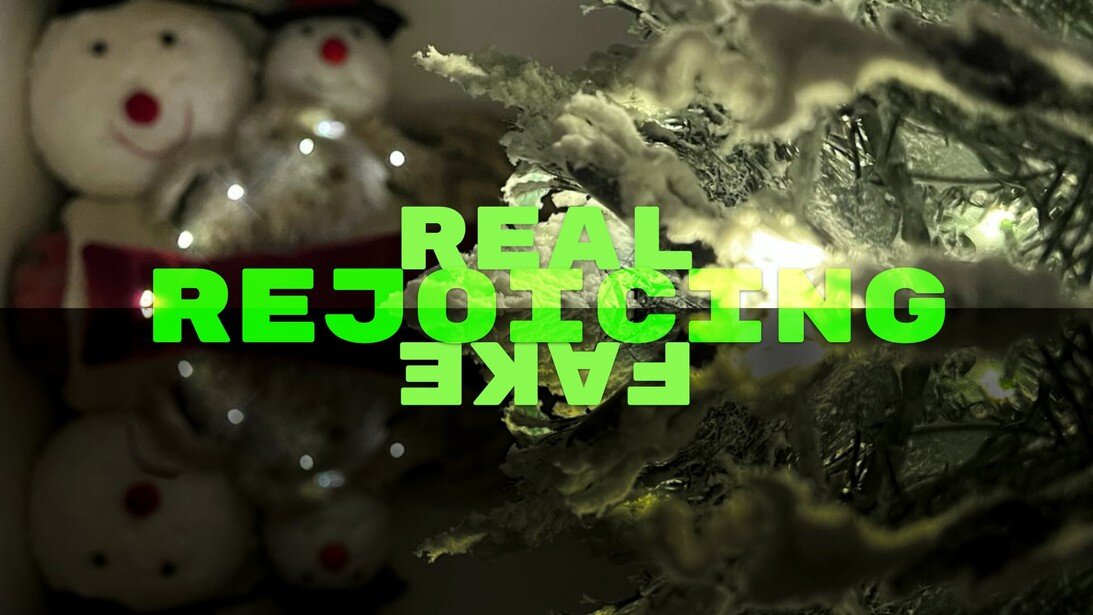
So it looks, on the surface, real. Sort of like something we’ve been seeing here. I meant to introduce that first. Got a little excited here. But you’ve already seen it.
Every time we start a service or a sermon in this series, we’ve been seeing this video, and remember a few weeks ago, can I confess something? I kind of misled you. I misled you guys.
So I talked about, in the very first message in this series, how that video had, that bumper video, had what was fake, right? The colors were wrong. It was upside down. And then it switched to what is real. Some of that wasn’t real either.
Let’s see if we can spot what wasn’t real here. Okay, here is, we go to real, right? Here’s the real section. Can you spot what isn’t real there? Do you want to try that? Want another pass? See if you can spot what, okay, let’s try that again.
Okay, now of course that isn’t. Okay, here we’re in the real section, allegedly. Can you tell what isn’t real? We have a vote for snowman. A vote for trees. Surfboard. Well, you guys are on the right track here. Actually, surfboard is real inflatable.
But you’re right to be thinking about snowmen and trees. Let’s take a look here. Take a look at this. Take a look at this. If you look on the left, the picture on the left, that is a real photograph of some snowmen I have. I fed that into AI because I wanted a video that could pass through it. And I got the picture on the right, which if you go back to, let’s back up here again. Let’s watch it one more time. If you watch through here, you’re going to see it actually kind of sweeps in.
None of that happened. Now, it was based on something real. That tree isn’t real either. You’re right. It looks like a watercolor, but very good, Kayla.
So the tree isn’t real, even though it looks like a real painting. It has real texture. And that snowman, well, it’s approximating a real thing that existed, but it’s not quite there. Sometimes the fake is almost real.
And it’s easy when you look at something like that tree I showed you earlier. If I hadn’t said anything and you’d pulled out of here, hopped onto 70, drove straight downtown because you were so excited about the tree, I’m going to take a family picture by that tree tonight, you would have gotten there, and you could have come up with one or two conclusions. One, wow, they take down Christmas trees quickly. Or more likely, you would have said, I don’t think that was real.
Would have been very cut and dry. But now, if you had walked in and you saw where I’d taken a picture of those snowmen, you saw them there, you might say, well, I thought they looked different in the video. But maybe my mind’s playing tricks on me.
And we get almost real. Almost a real clock in the background. Almost a real picture on the wall. Almost a real tree. Almost a real snowman. But not quite.
When we try to look faithful, a lot of times we’re closer to that almost real snowman. It’s not completely off. Ahaz is not completely off. Ahaz, if two hours before Isaiah had come, had said, God, unless you show me a sign, I’m going to make an alliance with Assyria. I know you said I shouldn’t have anything to do with them, but I’m going to do it anyway because I’m afraid. I’m going to do this. You better show me something or I’m going to do it. And you know what? Ahaz would have been right if he said, you know, I’m violating the law of God by doing that. I shouldn’t test the Lord. I should just obey him.
So there could have been a picture of real faithfulness. The key difference is a different situation, right? The prophet’s coming to him and saying, ask this of the Lord. I’ll give it to you. Ahaz says, well, let me now spout off that stuff. I would have been brave enough to do it before, but now I’m talking to a prophet of God, and things are sounding pretty good. I’ll go ahead and spout it off.
And it looks so close to real. And so often when we think we’re being faithful, it looks so close to real, but it’s not quite. It’s that AI-modified thing that doesn’t really exist but kind of looks like it. That’s perhaps one of the most dangerous places we can be because it’s so close to real, we can start to forget what is and isn’t real.
When I was putting together that slide with the two side-by-side, I was trying to remember before I pulled it up, well, how different is it really? What parts did carry over and what didn’t? And you start to forget.
And especially if we’re living sort of a semi-real faithfulness but not really a faux faithfulness, the longer we live it, the harder it becomes to even tell the fact that it’s not real because, well, this is what I do when I’m trying to be faithful to the Lord.
Ahaz thought he could. Ahaz wasn’t exactly the model of faithfulness, but maybe this is someplace he could hold on to at times. Maybe he hadn’t asked for a sign from God, and he thought, okay, I know I worship some other gods, and I don’t always worship the God I’m supposed to, but I’ve never asked Him to give me a sign. I’m a faithful man.
And sometimes that’s exactly what we do. We think, well, I know I have this whole box of areas I’m not faithful, but I’m not doing this even, and you know what? I’m even going further than what the Lord’s demanded there so that He knows that I’m really faithful.
And we start to feel proud about it. We start to pat ourselves on the back, right? Oh, look, I am faithful. Now, the moment that we start to pat ourselves on the back for faithfulness, that should be alarm bells all over the place.
The problem is we fool ourselves. It’s so close to real, we think, you know, that could be, but I’m looking at it, it looks authentic. It looks real. We need to look at what genuine faithfulness looks like.
Take a look at verses 14 and following. Isaiah says, Therefore the Lord Himself will give you a sign. You don’t want a sign. The Lord’s going to give you a sign anyway. Behold, the virgin shall conceive and bear a son and shall call his name Emmanuel. And he shall eat curds and honey when he knows how to refuse the evil and choose the good. For before the boy knows how to refuse the evil and choose the good, whose two kings you dread will be deserted. The Lord will bring upon you and upon your people and upon your father’s house such days as have not come since the day the Ephraim departed from Judah, the king of Assyria.
What’s happening there? Well, we’re telling Jesus, right? We know that. We’ve been in church enough around Christmas time. We know that’s talking about Jesus, and sure enough, it is. We’re told that in Matthew. So if the Bible says it’s talking about Jesus, we can assume that it’s talking about Jesus. That’s a good place to be.
But it also seems to be doing something else first. You see, this threat that’s coming to Ahaz, it’s imminent. The invading armies are ready to attack. Ahaz isn’t wrong to be afraid. Ahaz is wrong not to trust in God and to respond to God as God calls him to.
And what does God do? Even though Ahaz is unfaithful, God rescues the people. He says, I have a little bit more to do in Judah during this era, and I’m going to keep a remnant even beyond that so that I can bring salvation to the world. And so God offers salvation. He brings salvation upon the people. He says, I am going to rescue you.
And what do you know? Syria falls and Samaria falls. They fall to, well, Assyria, the one that Judah was going to align itself with, but without Judah becoming yet a vassal to it.
You see, if Ahaz had trusted in the Lord, Judah could have remained a politically independent nation. It could have continued on and not suffered under the oppression of one of the empires that was constantly conquering and being conquered.
And yet what we see here, what’s so heartbreaking, is because they wouldn’t trust, because they wouldn’t trust, Judah is on its last independent leg. It has about 100 more years before God destroys it, but during that time, it would be a shadow of itself. It would be under the thumb of the different empires, constantly indebted to someone to protect it.
All Ahaz had to do was actually trust that the Lord would protect him, and yet he wouldn’t. And yet, even with all that said, because he could have seen something so much greater, God continues to pour out faithfulness. He’s not going to let the story end just because of human failure.
Sometimes we think he will, but God keeps his promises, and he said he was going to preserve a remnant. He does preserve a remnant.
Assyria falls, Samaria falls, and they fall in short order. It’s not long at all before the enemies that were no longer exist at all. They’re just gone.
So how does this get fulfilled? It’s talking about this baby born, and the thought is, well, there’s been a lot of debate on this, but I think probably the most reasonable way to read this is a two-fold prophecy.
And the first aspect of it is that God is saying, Ahaz, this is a prophecy that’s coming to you. You’re going to know this. The others aren’t going to know this. But someone in your household isn’t even married yet. It’s going to get married. It’s going to have a child in the next few years, and because it’s a trendy name, perhaps, because it’s kind of scary out there, name the child Emmanuel.
And you know what? When you see little Emmanuel running around in your household and growing up, and you realize, wait, we haven’t been conquered. There’s actually an ability for a child to grow up here. You’re going to say, whoa, the Lord was right. Against all odds, we weren’t conquered. Against all odds, the unstoppable forces around us have been stopped, and we’ve survived.
Well, then how does this tie into Jesus? Well, little Emmanuel, little Manny, may have been running around, but no matter how much Emmanuel was running around, he couldn’t bring God to the people. God, of course, with the people, but God’s still also sort of distant, right?
But what would the existence of an Emmanuel in Ahaz’s time have meant? It would have meant that the dynasty, the line of David, lived to survive, to continue on, to pass down through the generations the calling that God had given to David, that there would always be a king on the throne of Israel descended from David, always be the Lord’s anointed, always be a representative of God that was on earth.
And because of that, even as it fell into disrepair and was all but forgotten, even as you could be a descendant of David and be of no regard in society, because by that point there were lots of descendants of David and no prestige because David’s family didn’t even have the least bit of hope of reigning in the light of the Roman Empire, even when you got to that point, the fact that you could get to that point meant that God had fulfilled this promise, and now he’s going to fulfill it further.
And that’s what Matthew’s point is too, that God is often layering his promises, and he puts down what we might call a down payment, not because he needs to, not because he’s not good for it, but because he wants us to see it.
And he gives this sign to Ahaz that Ahaz can experience that if Ahaz only would trust in the Lord, would only truly look to the Lord, it wouldn’t just be that God rescued him from one momentary threat. It would be that his family gets to play a role in saving everyone from the ultimate threat.
That’s exactly what God does. He just comes into the world. And Ahaz is in his ancestry. Yes, Ahaz was not a good man. Yes, many of the kings of Judah were not good men. And yet God took their unfaithfulness and his faithfulness overpowered it. They were unfaithful, but God’s faithfulness is genuine.
They were approximating faithfulness like we so often do, but God was genuinely faithful, and because of that, the Messiah came, the true Messiah, the full Messiah, the anointed one who wasn’t just anointed for a moment, but was anointed for eternity, the one who always will reign on the throne.
And so as we look to him, we say, well, he came 2,000 years ago. We’re going to celebrate that again in, well, I was going to say a couple of weeks, not even a couple of weeks now, less than a couple of weeks. We’ll celebrate it again.
What’s that mean for me? It’s great that God offered Ahaz a sign. What about for me? As I said, as we read his word, may we hear it, the God saying, your God says this. My God and your God. Not those people’s God. Not the special or the holy people’s God. If you’re reading it, your God is saying this to you. Those promises.
And so just as Ahaz, if he really would have interacted with God, he would have accepted the sign. He would have truly embraced what God was offering to him there. He would have seen just how vast the promise God was offering was.
So too, as we look to what God did 2,000 years ago, we’re reminded that he’s not done yet. And the fact that Jesus came into the world 2,000 years ago, and that he grew up as a human being, and he lived as a human being, and he suffered as a human being, and he died as a human being, and he triumphed over death, means that we can trust that he’s coming again, and that just as Ahaz had a promise that was going to be fulfilled again, in some sense it’s going to be fulfilled yet again, because that promise that the descendant of the line of David, the descendant of Ahaz, would continue to reign on the throne.
Well, Jesus is going to come back, and he is reigning, but we will someday be his people. As he reigns on earth, he will return. That is an amen, isn’t it? Jesus will return. Do we understand that so concretely?
Do we say to God, well, I don’t really need a sign. I’ll be faithful? No, God wants us to understand he really is going to do this, and that the signs that he’s given before are all pointing to the sign of his continued favor and his continued care.
And yet we chase after other things. We say, well, the sign in my life will be if I can keep reading the Bible every day for a certain number of days. The sign in my life will be if God answers my prayer for a new job and actually provides it. The sign for me will be if I can avoid burning anything when I’m preparing for company.
The sign will be, insert whatever it is that you wake up in the middle of the night, and if that comes on your mind, you’re not going to get back to sleep. If God solves that, that’s a sign that I’m being faithful and that he’s with me.
You know, an awful lot of those, they always come back to somehow being predicated on what we do. Because, well, that’ll mean I’m good enough for God. Maybe I’ll do these things, and then God will be faithful to me.
But for Ahaz, it wasn’t going to be how good he was. All he needed to do was actually trust in God, and that’s exactly what you and I are called to do.
And friends, if you’re a Christian, this call continues to be for you because the challenge is we say we trust in Jesus, and he saved us, and yet then we go right back to trying to trust ourselves.
And we need to keep checking for that counterfeit faithfulness because we often can’t see it, but you know who can see it? The people that don’t believe.
How often is it that the reason people won’t walk in this door or turn on to the live stream is because they’ve encountered again and again and again faithful people who are some of the nastiest, worst people ever?
And I say, well, I can get that without going to church. Why even get involved? We need to constantly be checking for what kind of counterfeit unfaithfulness we’re putting out and keep pointing to his faithfulness.
Because if Ahaz had been still the flawed individual that he was, if he had trusted in Jesus, the promise of Jesus at least, I should say. Of course, he didn’t know who Jesus was yet, but if he’d trusted that the Lord was working in this thing, we’re not told what all could have happened, but we’re told that this actually, this amazing promise and the continuation of the line, here’s the mind-blowing thing, it’s actually the judgment.
This isn’t the good thing that God was doing for him. This is what he’ll do even though Ahaz wearied him.
And notably, Ahaz is rejected in this passage. It’s interesting that when he’s first offered this promise, it says, your God is offering this to you. When he rejects it, Isaiah says, is it not enough to weary the people, but also my God?
Ahaz has made his decision. He’s rejected the Lord. God continues his line, but he doesn’t experience what it’s truly like to trust in him.
The key thing wasn’t that Ahaz wasn’t a great king. The key thing is that Ahaz wasn’t willing to trust him. He was trusting in this counterfeit faithfulness.
May we not do that? Once in a while, in this world, we have things that remind us on a more physical scale not to trust counterfeits.
September 29, 1982, I wasn’t alive yet, but I’ve heard the story. It left an impact. September 29, 1982, the first of seven people died from taking Tylenol. Why? Well, because someone had taken the bottles of Tylenol from the store, had opened the capsules that could be opened, poured cyanide into them, put them back together, put them back on the store shelf.
It’s never been completely conclusively proven who did this. They have a strong idea of who did it, but it was never completely proven. But the end result was seven people died. And then people saw this and copied it, and more people died.
Well, if you’re the manufacturer of Tylenol, you have a choice to make at that point. What are you going to do? Because people are now scared to buy your painkiller, and their market share just cratered.
So what did they do? Well, they discontinued capsules, and they came up with a brand-new gelatin-based capsule-like thing that couldn’t be opened. They also put multiple seals on the box and on the package so you could tell if it had been tampered with.
Maybe you’re in the habit that if you open the box of something like Tylenol, you always check the serial number on the box and on the actual bottle to see if someone maybe was sloppy trying to do something like this.
We have all these different ways to try to check is this a counterfeit or not, and it’s lasted year in and year out after that because it was such a profoundly scary thing.
But here’s the thing. They responded. They didn’t get everything right to begin with. They set up a system that allowed for someone to counterfeit a healthy product. But they responded. They repented, so to speak. They made something different. They added all these things. They said, We need to move over to faithfulness in producing this.
And it said within a year, the market share had been restored. People trusted it again because they saw something genuine.
That’s what God’s calling us to, to do something genuine. And the only genuine thing we need to do is turn to Him because every time we’re trying to trust in ourselves, we’re putting out things with cyanide in it because we can’t do anything but our fingers, they’re just too dirtied with the poison of sin.
So when we try to do it ourselves, even as we’re trying not to, we’re poisoning things. But God takes that and He purifies it.
I like what Otto Kaiser says. He said, There are situations in which outward piety and inward unbelief are identical. And I think even today, sometimes as I open that box of Tylenol and I look at the serial number, I think, Well, it looks like it’s genuine.
But someone who wasn’t sloppy, if they were tampering with it, they surely could put it in the right serial number box. You just say, Oh, here’s my poisoned box. I’ll put it in with the other one, right? I mean, it isn’t that hard.
And so the outward sign of genuineness might not be enough. And our outward signs of faithfulness, they’re not enough. It’s what’s going on in our hearts. That’s what God cares about. Not that we put on a good picture, not that we’ve been impressive, but are we actually responding to Him?
Marlene earlier read from the story, from the Gospel of Luke of the Christmas story and the encounter the shepherds have with the angel. And it struck me this week thinking about that because in that encounter, you have another sign offered.
The angels don’t just say, God’s done a wonderful thing. Believe and rejoice. They do. But what does the angel say? This shall be a sign unto you. You’ll find a baby wrapped in swaddling clothes.
And what do you know? They go and they find the baby. There he is in a manger. Just as the angel had said, God gave them a sign. They didn’t ask for it. They are given a sign. They believe. They respond. And they get to experience God’s promise.
That’s a call for each of us to set aside those attempts that counterfeit faithfulness, to set aside those false things we rejoice in, like Ahaz was rejoicing in. And as we see those rejected and marginalized in society like shepherds of that day, actually just doing the simple thing of God said it and I want to see it and I want to see this sign and to experience it, that we do the same.
And that where we can’t, we don’t try to somehow muster it up in ourselves. We just say, God, please give me the strength because I can’t do it. That we know that we can find it just as Ahaz could have. And that promise of God has not expired. And it won’t. The only place we’re going to find real, genuine, lasting faithfulness is from God.
But here’s the beautiful thing. That when we look to him, it focuses us and allows us to be fountains of that faithfulness to the world. That’s what he calls us to be.
Will you pray with me? Lord, we do pray that you would help us to be those who pour out faithfulness into this world. Not because like Ahaz we can put on a facade of being brave, of being pious, but rather because we want to pursue you.
Because we know that you’re the one who’s faithful. Lord, would you speak to those places where we’re trying to do on our own strength, where we’re trying to box it all up and we’re putting the counterfeit stuff together. Would you help us just to look to what’s truly faithful instead and say, God, I need you.
Lord, as we say that, would you work in us through your Holy Spirit. We pray in Jesus’ name, amen.
Start the Conversation