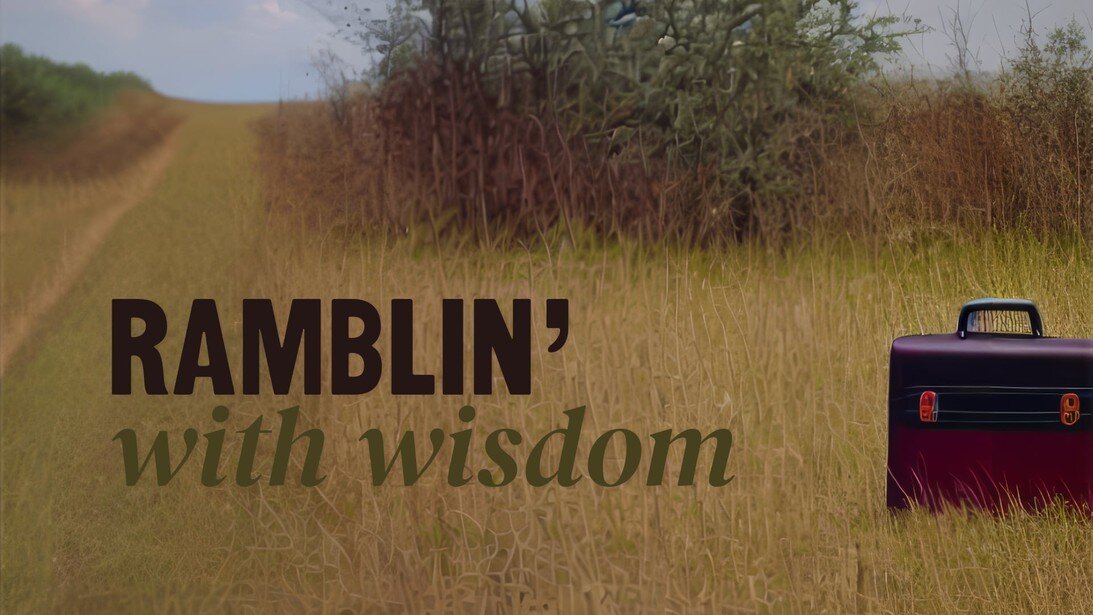
We all load our suitcases for life with what the world promises will make us wise—predictions, solutions, human answers—yet when Revelation calls for wisdom to understand the beast, it’s asking something far more unsettling: whose wisdom are we actually following?
The following study questions are AI generated and may contain errors.
The pastor uses the metaphor of a “suitcase of life” throughout the sermon. What are some examples of “human wisdom” we tend to pack into our suitcases, and how can we distinguish between human wisdom and God’s wisdom in our daily decisions?
The hoverfly illustration shows how something can appear to be one thing (dangerous) when it’s actually another (harmless). How does this apply to false leaders or false teachings in our world today, and what are practical ways to discern the difference between authentic and counterfeit authority?
The pastor argues that spending time trying to decode who the “beast” is in Revelation might actually be falling into Satan’s trap. What do you think he means by this, and how might this principle apply to other ways we seek to predict the future or figure out God’s plans?
Paul writes in 1 Corinthians 1 that God’s wisdom appears as “foolishness” to the world, while the world’s wisdom appears foolish to God. Can you think of examples from your own life where following God’s wisdom felt foolish by worldly standards, but proved to be right?
The pastor emphasizes asking “What’s God’s point?” when studying Scripture. How might this single question change the way we approach difficult or confusing passages of the Bible, and how could it prevent us from getting lost in theological details?
This transcript has been automatically generated and may contain errors.
I am so excited to start this new series. We’re actually doing a trilogy of sorts over the summer, a rambling trilogy going through Scripture three times, looking at different themes. One of the amazing things that we find in God’s Word is that God’s Word is consistent throughout. We see how the different parts of the story connect, and we realize God has tied it all together. He has prepared from the beginning of time the story of his redemption for us. That’s what we’re going to be thinking about.
Tonight we’re going to start in Revelation. We’re going to look at God’s wisdom throughout Scripture. We’ve been exploring God’s wisdom in Proverbs on Steadfast on Monday nights. Now we’re going to see where it is in the rest of Scripture over the month of June. That’s the first part of our trilogy. The reason we’re doing that is because we’re all traveling through life. We all have our suitcase of life with us, and sometimes it’s a little bit more literal than others.
We’re really traveling today at Little Hills because we can’t use our parking lot, so we are rambling about. We’re all at our computers separately and yet together as part of our online church family. So we pack up and we go to where we can be right now. That’s how it is in life, too, isn’t it? We sometimes know where we’re going, sometimes we find out on the day we were planning to do something that the parking lot isn’t sealed yet and we can’t use it. We don’t always know. But we start accumulating things: preparations, knowledge of stuff we study, tools that we buy, experiences, all this stuff. We start packing it into our suitcase of life so that we are ready for whatever we face.
The question though is, am I packing the right stuff in there? Because the world has all kinds of things that say we should pack in our suitcase. We load it up, and it gets to the point where we can barely carry it; we need some wheels on it because it’s so heavy. That suitcase is so heavy, yet we run into a situation where we think, now, God, why have you left me here? I don’t know what I’m doing. I have this whole suitcase, and I’m struggling trying to hold it because it’s so heavy. I don’t know what to do now.
Well, this may not be why we normally turn to the book of Revelation, but I think it’s a part of the reason why we should. We come to it with all kinds of the things that the world has packed into our suitcase. If we are going to ask questions of God, we should ask the sorts of questions like, what’s going to happen in the future? How can I know what the signs are? Those are the sorts of things we want; they’re the very things that people have demanded over time.
As we’re rambling about going down the road of life, we say, I want to know if there’s going to be some evil leader that’s going to rise. I want to know how things are going to shape up, how I should plan my life. God keeps calling us back to the same thing: there’s one thing we really need in this suitcase, and that’s Him. That’s what we’re going to see tonight as we turn to Revelation 13. So let’s go ahead and unpack that right now.
Take a look at verse 18. It says, “This calls for wisdom. Let the one who has understanding calculate the number of the beast, for it is the number of man, and his number is six, six, six.”
Revelation 17 verse 8: “The beast that you saw was, and is not, is about to rise from the bottomless pit and go to destruction. And the dwellers on earth whose names have not been written in the book of life from the foundation of the world will marvel to see the beast, because it was, and is not, and is to come. This calls for a mind with wisdom. The seven heads are seven mountains on which the woman is seated. They are also seven kings, five of whom have fallen, one is, the other who has not yet come; and when he does come, he must remain only for a little while.”
Let’s go ahead and ask God for his guidance as we contemplate this. It says that we need wisdom, and we might be thinking, well, what do I need to unpack from my suitcase to understand this? Because it’s perplexing. Let’s come before God and ask for his wisdom. Let’s pray:
Father, as we study your word tonight, we read Revelation, and it is perplexing. We don’t know how to make sense of it. We struggle. Different people offer solutions and possibilities. Would you help us to see what you would have us see in it? To see your truth, to see your love, and then be able to share that with others. We pray in Jesus’ name. Amen.
There’s lots of theories about what this beast being referred to here is. Who is it? What is it? And many of the theories you hear today—if you turn on the TV and you find a religious channel—they’ll be talking about the beast. Often it’s the next president, the presidential hopeful that they don’t like, or it’s some leader who’s charismatic in a different country. It’s that sort of thing. It used to be when there was the Soviet Union, the Soviet Union’s leader might have been the beast or whatever it might be. Going back further, you find examples of different church leaders people didn’t like, all that sort of thing.
Who is this beast? Many biblical scholars look at it and have found interesting ways, very fitting to apocalyptic literature, to take these numbers and come up with names through them. You see, much like Roman numerals that we’re a little bit familiar with, most ancient languages—the letters in the language had numerical value. You can zip right through them, just like that motorcycle zipping right by, zip right through them. You’d know them, like maybe you knew Roman numerals, or you know Roman numerals, and you know that means something.
Different results. For example, if you take a particular, peculiar spelling of the emperor Nero’s name, including his title, and you take it from Greek into Hebrew, and then you add up the value of the Hebrew letters, you get 666. Some people thought maybe this meant that Nero would return from death. The devil would raise him up as a fake Christ. Others proposed different evil emperors. In recent times, people try to figure out those numbers equal the name of someone they don’t like in our contemporary society.
But even early on in the church, there was caution against getting too into this because the risk is we start spending all our time seeing if we can add up a name that happens to hit this number, and we end up missing the message behind it. One thing we should ask is, if God wanted us to know the exact name, would he have really made it this hard to figure out? Would he write this book and provide it to us so that we would spend all of our time trying to calculate a number rather than whatever the point was outside of that number? Could it be more straightforward than that?
Some commentators have proposed, and I think this is actually getting more in the spirit of it, that what we really should look at is, throughout Scripture, we see that the number seven represents perfection. It represents creation. It represents God’s perfection of that creation. Seven days of rest, for example—the seventh day being a day of rest. We see those things. We see how seven comes up over and over again in Scripture, and it points to God.
Here we see one who can’t create, one who is a pseudo-creation, something that’s just pretending to be in power, someone who’s claiming to have the rightful place that God has, someone who is getting people to worship him, even though he’s a false god. And he has almost that number, and he has it not once, but three times. So God, who is seven and also is three in one, now you have three sixes—three almost gods. Exactly what we would expect the beast to be.
Now, does that mean that there isn’t some encoded name in here? Not necessarily. It could be that, too. But I don’t think that’s God’s main point for us. What’s clear is that there is persistent evil here. Here’s another interesting tidbit: if you add up the letters of Jesus’s name using that same technique, you get 888.
And so if we view Jesus as the fulfillment of God’s creation, the fulfillment of perfection, one over seven, then here we have an even clearer sign that this one falls short. Two under Jesus, one under perfection. Again, we don’t want to get into trying to figure out this numerical code too much, but what I think we want to grasp onto here is clearly 666 represents one who falls short, one who isn’t the one that should be worshipped, one who shouldn’t be followed, and yet looks so promising in the moment. So often we fall into that.
Take a look at this picture up here. You’ll see this picture, and I want you to give me your impression of what you see there. Okay, do you have a good sense of what you’re looking at there? It looks like a bee, doesn’t it? And yet it isn’t. That’s a hoverfly.
As we see this thing that looks like a bee or wasp, looks vicious, looks like it could sting you, the truth is that that thing can’t sting you at all. It’s relatively harmless. And yet it looks scary. What’s the point of that? Well, by looking like a bee, it gains the protection of being essentially a bee. It’s one who has taken bee wisdom, so to speak, and is able to use that to its advantage.
What we see when we talk about the devil raising up false Christs, antichrists, beasts—whether we’re talking about a singular one figure throughout the ages—we can see this happening over and over again. Satan always wants to raise up those who appear to have the power and the glory of God. He paints the bee stripes on a creature that isn’t a bee. We look at that creature and think, I need to respect this creature. It could sting me. I need to follow it because it demands that. It has that stinger on it; it has the stripes on it. Yet it can’t really do anything.
I see we’re being tricked into that. We need to know that we’re actually dealing with the authentic thing. That’s what God’s encouraging us to do in Revelation. If you really think about it, why are we being told that there’ll be those who rise up who are false? Is it so that we can spend our time trying to predict the future? Or is that actually one of Satan’s schemes? I think it’s the latter because think about it for a second.
What does Satan want us to do? He doesn’t want us to be focused on God’s glory. He wants us to be trying to be prophets, trying to figure everything out, screeching to a halt when God’s trying to call us forward into his wisdom and say, well, who is that? We spend all our time taking our enemies and labeling them as that rather than trying to actually understand what God has before us. And so here we are. We’re reading God’s word. We’re told that we need wisdom, and so we say, okay, I’m going to have wisdom. I’m going to add up these numbers the right way. What are we doing? We’re falling into the trap of chasing after human wisdom. We’re loading up our bags with the wrong wisdom yet again. As we do that, we’re going to fall short yet again.
And yet it has so much of human appeal. We want to know the future. We want to know how things end. Revelation tells us that but not in the way that we want it to. Sometimes we do this in other parts of life as well. A lot of times we do this in other parts of life, not just trying to figure out the future. It’s trying to figure out, how do I live today? We take a little bit of God’s wisdom and dress it up with lots of human wisdom around it to make it seem more applicable, to make it more comforting, to make it easier to wrap our brains around.
For example, take a look at Colossians chapter 2. We read in verse 23: “These have indeed an appearance of wisdom in promoting self-made religion and asceticism and severity to the body, but they are of no value in stopping the indulgence of the flesh.”
Paul’s talking about the various customs that are being proposed, the different ways of importing the law and the traditions of the Jewish law into the Christian gospel, maybe even going stricter than it ever demanded, even the tradition demanded, which had gone stricter than what God had demanded in his law, to somehow bring about a sense of holiness, somehow overcome the sins of the flesh. And yet Paul says, that’s not going to work.
Why is that? It’s human wisdom. We’re bringing in a legalism. God isn’t legalistic. God does call us to his law, but he’s not legalistic. And so as we build things on, thinking that somehow we’re creating a holier picture, we’re painting those bee stripes on more human wisdom. Sometimes we go the other way with that, and we start to chip away at God’s law. We say, well, God doesn’t really care if I do this or that, he doesn’t care if I live this way or that way, it doesn’t matter because God’s so merciful. We start painting all kinds of mercy stripes on things God has said don’t do. These things aren’t pleasing. They aren’t leading you to life. They’re leading you to death. And so it’s not really mercy at all, but it looks that way.
What are we loading in our suitcase? Are we loading God’s wisdom? Because as we travel, we’re going to be confronted with these things over and over again. We as individuals, we as a church, have the challenge: what am I doing? What am I loading into my suitcase? I think John’s challenging us in Revelation to think about that.
And here’s the very clear thing: We may not know who the beast is, how this exactly plays out, how much of it happened in the past, how much of it will happen in the future. Good, faithful people will disagree on these things. But what we do know is that it is a picture of what happens when people walk away from the Lord, when they follow one who claims the glory of God but isn’t God, when we follow one who says, I have everything under control. I’m the one that’s going to make things right for you. That’s really God’s place.
I like this quote from one commentator. He says, “Civilization without Christ is necessarily under the dominion of the evil one.” That’s what we see a picture of in Revelation. We see it in the history of the world as well. We don’t have to look to the future. Every time civilization tries to be quote-unquote civilized without actually doing what’s pleasing to God— even in the church—when we try to be civilized and we try to apply God’s word, we start pouring in more and more of our human wisdom rather than God’s wisdom. What happens? We’re giving more and more of the kingdom over to the evil one rather than to God.
We need to keep it in God’s domain because that’s where our hope is. That’s where everything works. 1 Corinthians chapter 1 verses 20 to 24: Listen to what Paul writes there. He says, “Where’s the one who is wise? Where’s the scribe? Where’s the debater of this age? Has not God made foolish the wisdom of the world? For since in the wisdom of God the world did not know God through wisdom. It pleased God through the folly of what we preach to save those who believe. For Jews demanded signs and Greeks seek wisdom. But we preach Christ crucified, a stumbling block to the Jews and folly to the Gentiles, but to those who are called both Jews and Greeks, Christ, the power of God, and the wisdom of God.”
God’s wisdom solves every human problem. This is where Paul repeatedly challenged those he ministered to. I believe John is challenging us as well as we look in Revelation. We go to human wisdom over and over again. We should ask ourselves, how would a beast rise up? How would a beast get any followers at all? We imagine this gnarly, horrible creature that no one would want to follow. That’s not how it works though.
How does evil arise? Evil arises by appealing to us, by looking beautiful, by painting a picture of hope. If we look at the most wicked rulers over the course of history, how did they get power? Quite frequently through looking like wonderful, heroic leaders in the moment. That’s how the devil works. He paints a picture that looks good. He paints those bee stripes on, and it looks like we’re dealing with a bee but we’re not.
What’s the cost of mistaking a hoverfly for a bee? Well, not really all that much. Now, if you go the other way around and think, well, this is a harmless little creature, and then you mistake a bee for a hoverfly, you get stung and it hurts. How much more when we take human wisdom and we load that into our suitcase so that we’re going through life thinking we’re being wise. We’re hearing this invocation in Revelation, “Let the one who is wise do this,” and we think, I’m being so wise. I’m predicting the future. I’m figuring this out. I’m labeling my political enemies as clearly the bad guys. They’re the ones here in Revelation. Or those people I don’t like at church—they’re clearly the ones that are the false Christians here. I need to deal with them. Or my neighbor who doesn’t believe, he falls in this deluded camp but I don’t. And we do that over and over again.
We’re falling short of where God’s calling us to be. Because here we are thinking we’re so wise and we’re missing out on God’s wisdom. God’s wisdom is exactly what Paul says here: It’s foolishness to the world. Paul says this to the Greeks as he’s writing to the Corinthians, people who valued wisdom, people who wanted to be thought of as wise who sought after philosophers who could give the wisdom of the world. And Paul’s saying, guess what? Hey, I’m here and I am foolish, and it’s exactly the wrong message, except that it causes them to have to wrestle with the Holy Spirit instead.
Spirit’s the one that’s going to say to them, no, this is actually wisdom. It’s not going to be the philosophers of the world, the people that normally authenticate wisdom. It’s going to be God. That’s the only one. He’s the only one who can actually help us to see true wisdom.
Revelation chapter five has that call to turn around and do a U-turn just like the guy behind me did a moment ago: “Worthy is the Lamb who was slain to receive power and wealth and wisdom and might and honor and glory and blessing.” You see, we turn to all these things of the world. We offer them glory. We say, here’s someone worthy of praise. Here’s someone who can save the day. Here’s someone who can give me hope. Here’s me, myself. I will give me hope. I will make things right. I will get everything understood that needs to be understood in my life. I will read Revelation and I read that thing about wisdom. I think, ah, I’m in that because I have wisdom. I’m reading the right people. I’m thinking the right thoughts.
Those aren’t the right tests. The right test is God working in my life. It’s the Spirit giving me his wisdom. Are the things I’m thinking, are the things I’m doing bringing glory to myself, to other human beings, or to God? That’s going to be the determining factor. That’s what we should be looking for.
Notice here the problem. People are worshiping the wrong one. They’re worshiping this creature who claims glory rather than God. It doesn’t matter if it’s Nero. It doesn’t matter if it’s some future person. It doesn’t matter if the person’s already been born or will be born in a hundred thousand years from now—that person isn’t God. Are we worshiping God?
The message that the Corinthians heard, even though they had followed and they’d responded to Paul, some of them were being chipped away. Some of them were having doubts because they heard these philosophers saying, well, that sounds foolish. You follow a guy who was nailed up on a cross as a Roman insurrectionist? What kind of idiots would do that? What do you think that’s going to do? You follow a group of people who say the body’s going to be raised from the dead and actually have physical existence again? Don’t you know this physical world is flawed and broken? What kind of gullible person would believe that?
When Paul said, well, what I preach is foolishness, there were people reading that letter, nodding their heads saying, yes, Paul, exactly. That’s what we’ve been saying. You sound foolish. Because by our human standard, we look at that hoverfly and we think it’s a bee. We pack up our suitcase and it feels really heavy. We have lots of stuff in here, but it’s not the right stuff.
What are we loading up with wisdom on? What we need to remember is that God has wisdom. We humans don’t. We humans are gullible, all of us, not just certain ones that we look at and disagree with. We’re gullible, too. We lack wisdom, too.
How do we get wisdom? How do we respond when Revelation says, let the one who has wisdom do this? Well, turn to God and ask for his wisdom. That’s why we pray as we go into a sermon. We don’t assume that I’m going to preach a sermon that’s going to solve all the world’s problems and get everything right. We don’t assume that everyone sitting here tonight is going to get everything just right. We assume that God already has got it right and we need his help to understand it. I need his help to preach this. We all need his help to understand it and his help working in our communities so that we can help each other understand it.
Here’s the big question we should ask, not just in Revelation, but if we want to demonstrate wisdom, true wisdom, godly wisdom, as we go through God’s word, we always need to ask one really big question: What’s God’s point?
I can’t solve all the mysteries of Revelation for any of us. I wish I could. I wish I knew everything. At one point, I thought I pretty much had it down, and then I realized, wait a second, I don’t. I don’t believe anyone today can fully explain Revelation. We can offer some pretty good theories. We can see some of the pieces and how they fit together. But here’s the thing that’s very clear in Revelation, even when some of the details aren’t: It’s about God’s glory, God’s wisdom, God’s victory. That Jesus has triumphed over Satan. Jesus has triumphed over death. Jesus has triumphed over everything broken and is the triumphant king whom we should follow.
You see, we let our human wisdom be the boss and so we get focused on putting together the puzzle pieces to predict the future. We let our human wisdom be the boss and we start changing God’s word; we add on requirements that aren’t there because we think we’re going to solve things, or we take away requirements because we think we know better.
We need God’s wisdom to be the boss because when God’s wisdom is the boss, we have the best boss ever, the only one who leads us where we should be. We have the loving king, and he’s not just a boss. He’s not just a king. He’s our heavenly father who loves us and is with us every single day. He’s with you, and he’s with me. He reminds us of that through his supper that he gives us. We see at the end of Revelation the coming banquet where someday we will be in God’s presence. He will wipe every tear from our eyes, and he will invite us to actually dine with him.
As we take the Lord’s Supper right now, it doesn’t seem like it makes any sense. It seems like more of that foolishness, like why don’t we just go do something useful rather than taking a little piece of bread and a little cup of juice. But as we turn to those things because God has said those things will bring you into fellowship with me, what happens? Through the power of his Holy Spirit, he allows us to experience the fellowship he gives us. That’s why it’s so important that we actually know Jesus before we partake.
If you haven’t, let tonight be the night that you actually ask Jesus to be your Lord. Let his wisdom guide you, not my wisdom, not the wisdom of others in this community, not the wisdom of someone else you find on social media or in real life, some set of books, anything. Let God’s wisdom be the ultimate guide. Doesn’t mean all those other things aren’t useful. God has given us the gifts of the wisdom that we use to figure out how to build roads and cars and medical technology and online live streams so we can talk about God’s word together and all this stuff. But let God’s wisdom be the thing that dictates it. Because even God’s word itself, when we let human wisdom be the boss, will be distorted. But when God is the one directing our thoughts, when we ask the Holy Spirit to help us to see his wisdom, then we’re amazingly rewarded because we are in the very presence of the heavenly father.
So it was on the night he was betrayed. Jesus took the bread and he broke it and gave it to them saying, “This is my body, which is for you. Do this in remembrance of me.” And in like manner, after supper, he took the cup and said, “This cup is the new covenant in my blood poured out for you under the remission of sins. Do this as often as you drink of it in remembrance of me.”
As often as you eat this bread or you drink this cup, you proclaim the Lord’s death until he comes.
Let us pray.
Father, we come before you as those who lack wisdom. We need your wisdom. We need your guidance. By the power of your Holy Spirit, we pray you take these elements and you would nourish us with the very body and blood of our Savior Jesus, the only one who has true victory. For in him truly is all the wisdom and power and glory and honor forever and ever. Would you bless these elements and guide us both in this moment and this day in this life. We pray in Jesus’ name. Amen.
Start the Conversation