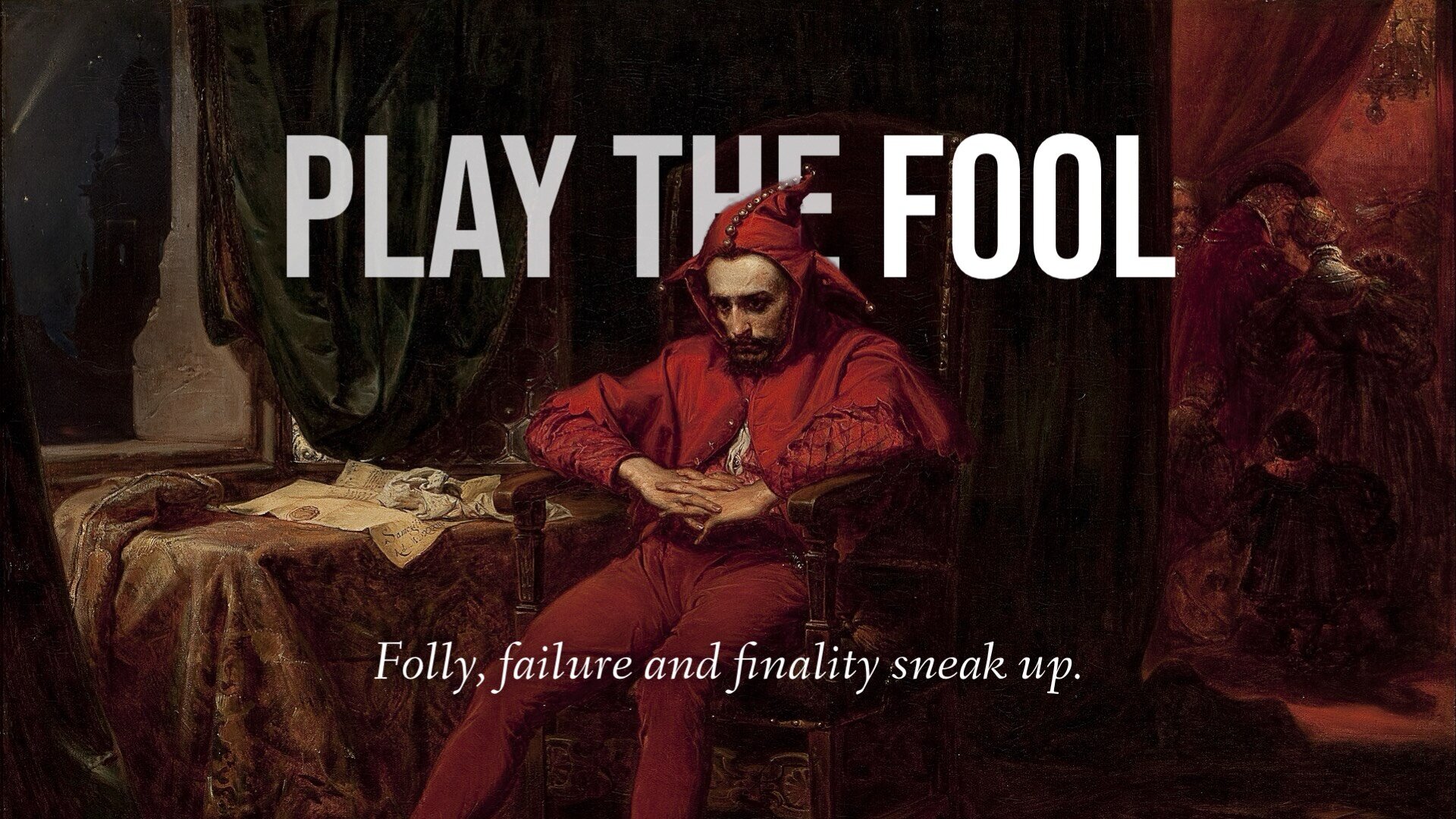
We know the word fool, but do we recognize who the fools are? Do we recognize when we’re the one playing the fool? Psalm 14 helps us better understand real foolishness.
The following study questions and transcript are AI generated and may contain errors.
The sermon distinguishes between three types of fools: the court jester who speaks truth to power, the modern atheist activist who openly rejects God, and the biblical fool who simply doesn’t seek God. How does the biblical fool differ from the other two, and why might this type of foolishness be harder to recognize—and more dangerous—in today’s society?
The speaker argues that saying “there is no God” in one’s heart often means “I don’t really care about God” rather than outright intellectual atheism. Where in your own life might you be functionally saying “there is no God” by neglecting to seek Him in a particular area, even while affirming belief with your words?
The sermon uses the illustration of collector’s items—Christmas ornaments and unused coffee makers sitting on a shelf—to describe how we can treat faith as something to admire rather than use. What parts of your faith, or your church’s life together, might currently be boxed up on a shelf? What would it look like practically to take them down and put them to use?
The speaker references the Pharisees as people who appeared outwardly wise and godly while actively rejecting God. Drawing on Psalm 14:2 and Isaiah 55:6–7, how can we distinguish genuine seeking from merely maintaining a socially acceptable appearance of faith? What safeguards help us avoid the Pharisees’ trap?
What practical steps can we take—individually and as a community—to discern the subtle disguises of foolishness, resist the pull toward spiritual apathy, and consistently pursue the path of wisdom that actively seeks God in every area of life?
The following study questions and transcript are AI generated and may contain errors.
What does it mean to play the fool? We mean different things by it at different times, but part of it is what’s progressed over our course of history in a very different way from what people thought of it as a few hundred years ago. A few hundred years ago, if you had been the fool in the king’s court, it wasn’t that you were actually stupid. No, you were actually the one person who was allowed to say what the king actually needed to hear. But we don’t really mean that. We think of fools, even a fool like the one we just saw, not as someone who’s going to tell the truth, but someone who’s going to make jokes and maybe be stupid.
Being a fool can mean all sorts of different things, and the Bible actually has another idea of what being a fool is versus what we think of at all. That’s sometimes where we run into trouble when we read about the fool in the Wisdom Liturgy. Hi. I’m so glad that you are here today as we begin a brand new series, Play the Fool. And if you would, if you’d go ahead and hit like or share, invite people to join us in this study. We’re going to be going through Psalm 14. That begins with the character of the fool, but not the fool in Motley. Not the fool that tells the truth. Maybe a fool a bit more like the fool that we think of, but not really that either, but this third type of fool.
A fool whose foolishness isn’t the fact that he’s a jokester, isn’t the fact that he dresses oddly. In fact, the fool that we encounter probably looks respectable and normal and maybe even wise. But unlike the court fool, he actually isn’t. Let’s go ahead and pray that we would be those who are discerning, that we can understand the difference between being a fool and just fooling around and making jokes and frivolity and being a fool in the sense that often sneaks under the radar, but is vastly more dangerous and comes in a lot of different disguises. A lot of things that are a lot less apparent than a medieval or Renaissance fool’s Motley. Would you pray with me, please?
Father, thank you for this evening. Thank you for your word. As we dig into this new series and we look at Psalm 14, would you help us to think about what foolishness really looks like and to be those who can discern it and run from it, that we would run towards true wisdom, that we would run towards you. We pray this in Jesus’ precious name, amen. Let’s go ahead. We’ll dig right in. Let’s go into Psalm 14. If you want to turn there with me, verse one, here’s our fool.
The fool says in his heart, there is no God. They are corrupt. They do abominable deeds. There is none who does good. There are a number of different ways we can be genuinely foolish, but the one we see here first is a, in some sense, passive way. Now you might say, but the fool is saying this, right? He’s saying there is no God. That sounds very active. But what it really seems to mean more than anything, because he’s saying it in his heart, he’s not saying it out loud. He’s not in the court declaring to the king, there is no God. He’s saying quietly in his own heart, there is no God. Why does he say that? Because what he’s really saying is, I don’t really care about God.
We have to remember in the ancient world, it was really hard to find genuine atheists. So when we read about someone saying there is no God, like this fool, the biblical fool probably isn’t an atheist in the sense we think of today. It isn’t an atheist in the sense that someone is protesting there is no God and fighting so that people cast away ancient superstition and believe that there’s just a cold scientific natural reality that has no creator, no origin point, just somehow is. That’s not what we’re encountering here. Not a modern day atheist back millennia ago.
What we’re really encountering is someone who says what all too many people throughout the ages have always thought. There may be gods. And that’s the thing. Especially in the ancient world, they thought there were lots of gods. There may be gods, but I don’t really care. Why does he say there is no God? Because he just doesn’t care. It’s the quintessential path of the real fool. The fool that’s harder to detect because he doesn’t have brightly colored clothes on.
Take a look at Romans chapter 1 verse 22. Claiming to be wise, they became fools. Paul’s tracing how people turned away from God even though the creation itself testifies to the creator. And Paul says, one of the key things they did is they claimed to be wise, right? These fools claim what the court fool didn’t do, even though it was true in that case. The court fool didn’t go around claiming he was wise. The whole idea was to play this mad role while saying the wise thing so that the king wouldn’t kill him, right? And the king even allowed that to an extent. Kind of a funny little thing, the kind of rationalization we do, oddly enough, even though it doesn’t make sense, right? I want you to act like you’re stupid, so you can tell me the stuff I need to hear, but I can’t blame you for it when I get angry that you’ve told me it.
Well, that fool is wise, the person asking for the advice, not so much. The fool that’s trickier is the one who claims to be wise and appears to be wise. And that’s the sort of fool that we find in scripture. He looks wise. And so, when we listen to him, we don’t discount him because, ah, he’s the mad fool. We listen to him because we say, ah, he’s the wise sage. Kind of the funny thing. In some sense, that’s done great harm to us that we think of being a fool and thinking it’s someone who’s very obviously that, when what scripture says is that the fool, he’s right there in society, and what do you know, he’s actually a lot more like us. Why does scripture keep talking about the fool? Not because you can easily tell the fool and you can always run from the fool, but rather because it’s very hard to discern the fool. He just doesn’t want God’s expectations on him. God’s not important in his life, as one commentator put it.
And when you think about it that way, suddenly the fool isn’t this weird, rare character that we wonder if we’ll encounter some day, sometime. He sounds a lot more ordinary. He sounds a lot more like what we encounter every single day because he isn’t crazy in his appearance. He isn’t crazy in his words. On the surface, it’s something going on deeper in his heart. Commentators have actually observed even, because he’s saying it in his heart, that seems to imply perhaps what he’s saying out of his actual mouth isn’t the same thing at all. He might actually say he believes in God. Ah, yes, I believe in God. I’ll go to the temple. I’ll do the things I’m supposed to do.
The difference is what’s driving it. Is he actually believing it, or is he taking up a facade, an appearance, just intended to allow him social acceptability? And in that way, maybe there is a parallel to that fool of the king’s court. Both of them take up appearances. But while the fool of the king’s court is taking up an appearance of wisdom, rather foolishness to cover his wisdom, the real fool, the fool we need to be worried about, takes up an appearance of wisdom to cover his foolishness. He claims to be wise, and all too often we believe that he is wise. We actually think it. And it’s hard to see what’s going on in the midst of this, because he seems to get ahead, and people seem to respect him, and it seems like maybe there’s something to this.
A couple decades ago, there was a big bunch of stories and movies and books and articles coming out about the new atheists, and they were going to just revolutionize the world. People like Richard Dawkins. And each of them, they weren’t necessarily theologians or philosophers, even of the atheistic sort. That wasn’t their main focus in life. But they came from different scientific fields, and they said, and we’re going to speak to how we should live without faith. And they were passionate about this, right? They were going to convert people to atheism. They were the most religious atheists you could imagine. Maybe you know someone like this still. But the implication a couple decades ago is this is going to take over the world, right? People are going to hear this, and they’re going to believe it.
And for the most part, even as our society has in many ways become less religious, the new atheists fizzled out, because it’s sort of religious atheism. I am passionate about demonstrating to you that the things you believe in don’t exist. It just doesn’t appeal to most people. And if that’s our picture of who the fool is, this person who creates movies, the God delusion, to demonstrate how God doesn’t really exist, and that’s what it means to say there is no God, it’s pretty easy to guard against. Well, I just won’t go see a movie that says it’s going to demonstrate how God doesn’t exist. That’s foolishness.
But what about the fool who actually says there is a God? He just doesn’t care. And so he does enough, enough to be socially acceptable. But because he doesn’t really care, he doesn’t do what really matters. And because he doesn’t care and doesn’t do what really matters, but is right there with us, guess what? We can soak that up. We can start to sort of say there is no God, too. Not in the sense that we outright reject belief, but we just don’t care. We just are too busy doing other things. And at some point, probably all of us are going to have a moment like that, where we’re just so busy doing other things, at least functionally, we just don’t care in the moment. I have other stuff to do. Kind of forget God. And to the extent that we believe, we just sort of soften it, right? We’ll put it on the back burner. We’ll deal with this another time.
That’s part of what’s being talked about here, just that passiveness. But then there’s also an active component, and it’s not the active component we often think of, this idea of the missionary atheist, but rather the missionary apathetic. I don’t want to seek after God. And that’s what we see as we go on to verse 2. Take a look. The Lord looks down from heaven at the human race to see if there is anyone who is wise and seeks God. As we’re going to go on and see, the answer is, well, no, people don’t seek after God.
Why is this paired with the person who’s declaring there isn’t God? Because really, the more disturbing thing is that we actively go from, I just don’t really care, to I am actively going to seek after other ways. I’d rather seek after something other than God. I want to say I’m wise. The Bible says, well, what’s wise is you’d seek after God. And we say, well, I’m too busy being wise to seek after God. I’m too busy studying this or that or the other thing. And study is a good thing. It’s good to know things. It’d be great if we had more Christians who are scientists and Christians who are exploring different parts of the universe, Christians who are poets and Christians who push the limits of human culture in every way possible, but with a desire to seek after God. That would be really great.
And at times it’s been true. It hasn’t been as true lately, because oftentimes we think, well, maybe if I go there, that’s where the fools are, I’m just going to soak it in. And we’ve abandoned it. That’s not the point here. The point is, our measure of wisdom isn’t, do we have a lot of knowledge? Can we pass certain standardized tests? Do we have certain credentials and degrees? Do we have those things? But do we seek after God with whatever we’re doing? Is there anything in our life? Is there any place in your life and in my life where I say with my lips, yes, I believe in God, but functionally in that area of life, I’m saying there is no God, right? I just had this little nice isolated area and God doesn’t need to worry about this area.
And sometimes that is outright sin, right? There’s just something sinful in our lives we don’t want God to touch. But a lot of times it’s not necessarily outright sin, it’s just a lot more convenient just to worry about our own concerns in it, which is of course sin. But the thing itself could be good if only we’re bound to seeking after God’s will, seeking after wisdom. Something intrinsic to it that’s bad. What we saw last night with the Pharisees. The Pharisees said they were wise. People thought they were wise. They weren’t dressed in motley looking foolish, no. They were dressed in the most respectable robes of the time, looking like the leaders and the authorities and saying seemingly godly things, only they were busy rejecting the very God of the universe while they were doing it.
Spending all kinds of time studying scripture, sinful. Was teaching God’s law sinful? No, it wasn’t that. It was that in that they had said, I don’t want to seek after God in this if what God has in there for me to seek is different than what I want. I’d rather reshape God. And when we reshape God, that’s the most subtle, sneaky, and ugly form of atheism there is. Because we’re saying something we can only do with something that simply doesn’t exist. Reshape it. We can’t reshape a person. Can’t reshape any living being, right? Try to get my cat to do something I want him to do and he’ll be busy trying to reshape me instead, right? He has his own ideas and yes, as creatures with ability to learn that God has given us, we may encourage each other, but we can’t just outright rewrite each other, right?
And what we do when we say, I’m going to read God’s word the way I want it. I’m going to make it the way I want it. We’re saying, well, but we can’t rewrite God. Can’t do it with my friends and family. I can’t do it with my cat, but surely I can do it with God. Do we understand what we’re saying about God when that’s the case? When we say, let’s start with what I want and then I’ll talk about how that applies to God. If we’re not at times having to give up our views, if we’re not at times having to change, if we’re not at times having to actually be the ones being reshaped by the only one who actually can shape, the one who actually formed us, if that’s not happening but we’re trying to do the opposite, we’re playing the fool.
God says, there’s time to change, and now is the time to do it. Take a look at Isaiah 55. Seek the Lord while he makes himself available. Call to him while he is nearby. The wicked need to abandon their lifestyle and sinful people their plans. They should return to the Lord and he will show them mercy to them and to their God, for he will freely forgive them. God says he will freely forgive us. We just need to turn and seek him. And that’s a message for all of us, not just if you’re trying to figure out what you believe. All of us need to be constantly being reminded to seek God, because even after we believe, it’s so easy to move away from seeking God in one area or all areas of life. There’s times where we’re just spiritually in a dark place and we’re not seeking God anywhere. There’s times where we’re pretty well focused on where God wants us, but there’s a few areas we’re holding back. But whatever it might be, there’s going to be some place that we need to seek God right now. Some place today that you could be seeking God more than you are. Some place today that I could be seeking God more than I am.
It’s not just enough to demold the words like the fool who has the social acceptability. You think about this. We know the difference between buying something to use it and enjoy it and make good use of what it was intended to do and collecting it. Sometimes things are made to be collected, but it still changes, right? We’re not going to enjoy it in the same way.
Every year in July, so just a couple weeks ago, Hallmark debuts their Christmas ornaments. And so you can go and you can look at the keepsake ornaments. And if you go and look at them, here’s the notable thing about that. I’d imagine a few people go in July and they actually buy ornaments for their Christmas tree, right? They’re just ready. I’m going to have this. I’m going to have it so I can enjoy it at Christmas. But what are a lot of people doing if they’re going to show up that early? They’re those who collect certain ornaments and they’re going to buy them in case they sell out. And it’s become less of a thing with Hallmark ornaments lately, but there are all kinds of different things people collect. And the people who rush out when it’s not really useful yet, but it’s newly available. Those are people usually who are going to collect them.
And so you put the ornament boxes on the shelf. And of course, there’s the ornament inside and the little hook to hang it on the tree and all that, but it’s not going to be used. It’s going to sit there so it can increase in value. Maybe it’s not ornaments. Maybe say it’s baseball equipment. You have some baseballs. They were meant to be thrown. They were designed to be thrown, but you set them on the shelf, right? Because maybe they’re autographed. Just going to set them there because throwing them then would damage. Sometimes that’s the way we are with God, right? We say, well, I have this nice faith and it’s all nice and it’s in the box and it looks pretty good. And I’m just going to put up on the shelf and then I’m going to go about my day, right?
The thing with when you’re collecting things, those things aren’t changing how you work during the day. If you collected coffee makers, this would be absurd. You should always use a coffee maker because it makes coffee and you don’t want to miss out on that coffee. But if you collected coffee makers and then you’re not drinking the coffee, you just have these nice boxes on the shelf, we’d say that’s crazy. We can see that with that because it’s meant to do something. But with the ornament, we can kind of say, well, you know, they kind of were marketing it for collectors. Maybe that’s okay.
And here’s the danger with seeking after a God. We tend to put them in the category of it’s okay to collect, right? I’ll learn all these scriptures. I’ll memorize them. I’ll put them on a nice shelf and I’ll pull them out sometimes and kind of look at them. And God says, well, but I want you to seek after me. I want you to actually open the box, hang it up on the tree. I want you to open the coffee maker box and plug it in, have a refreshing cup of my grace ready to caffeinate you with something far better than caffeine. I want you to have that.
In fact, it’s what the wise life looks like. We say, but God, I have the boxes. I have the ornament box. I have the coffee maker box and it looks really good on the shelf. And I just like to leave it there because it looks good. Sometimes we even do that with how we approach what ministry should look like, right? Think about our churches and we want them to function to a degree, but sometimes we treat them kind of like collector’s items. I like how it functions like this. So let’s just leave it like that. Not because it’s right. Not because it’s good, but because it feels comfortable in the moment.
You know what? Jesus kind of becomes a window decoration. One of those boxes we put on the shelf and can look at or hang in the window, but we don’t actually do anything with it, right? And so if the church itself goes off the rails and is teaching false things, but Jesus is still there hanging in the window looking, okay, we just go with it. Or we’re teaching the right things, but we never actually have any passion for reaching the community. We just go with it because it’s comfortable. But the fool says in his heart, there is no God. He doesn’t seek after God.
But God says, I want you to seek after me. And what does that mean? You take all the parts of a living faith and you take them off the shelf and you unbox them and you start using them. In our own lives, we ask God, where is it that I’m just sort of, yeah, people know I believe in you, but I’m not actually doing anything. Help me to do something with it. Help me not to say in any part of my life, there is no God, even in just the way that I use you like a bumper sticker or a boxed collector’s item. Help me to take it off the shelf. I mean, we do the same in our church, right?
How can we say, God, we’re together and I really believe at Little Hills, we see God working and that everyone there wants to do something with it, but we should be constantly seeking so we don’t become complacent. God, what parts of what you want us to be as your people are sitting on the shelf and we haven’t pulled them off? Where are those places that you’re calling one of us or all of us to do something for your kingdom where right now it looks like we’re basically saying there is no God, because we’re doing our thing and we’re comfortable with it and it’s a nice collector’s item and we’re okay with it?
You see, this passage isn’t about a nice, comfortable thing because they say, well, I’m not doing that. I haven’t posted on Facebook, there is no God. I haven’t gone into the office and shouted, there is no God and therefore I’m not doing this. I’m not the fool. That’s just so much more than that. It’s not just about not mouthing those words, because the fool is saying it in his heart. He’s not even saying it out loud. The problem is the one who either just doesn’t care or actively rebels or actively rebels and says, I’m going to seek something else. It’s so funny how often we don’t think of that as rebellion. We don’t think of putting the parts of what God has given us on the shelf as rebellion. We think sometimes it’s quite respectful, right? I’m taking care of it. I dust it every once in a while.
But God says, don’t just dust my faith that I’ve given you. Use it. Here’s the beautiful thing when we do. It doesn’t wear out. Same faith that millennia ago could have this psalm written about it is still active and in perfect condition. We can’t chip it. We can’t scratch it. We can’t get it all muddy and dirty and stained. We can’t ruin what God has given so we can use it. We don’t want to be those who play the fool that say, there is no God. Here’s the thing we need to do. We need to seek him. That’s the one thing we can do. We can’t get it right if we try to do it on our own. But when we seek him and we say, God, show me those places I’m not seeking you and help me to seek you there and seek you here and seek you over there and encourage other people to seek you. Guess what? That’s what the path of wisdom versus the path of the fool looks like.
Let’s pray today that that’s exactly what we do. Would you pray with me, please? Father, thank you for the wisdom that you give us. Would you help us to see those places where we treat faith like a pure collector’s item? It’s just an ornament box we put on the shelf. Or it’s sort of a quirky collector’s item, like a coffee maker, put on the shelf, even though I could use it for something. Or would you help us to see both? The beautiful, ornate parts, they’re meant to be pulled off the shelf and enjoyed and used to glorify you. And the more functional parts, they’re meant to be pulled off the shelf, too, to refresh us.
And sometimes we’re sitting there in the doldrums wondering why we’re not spiritually alive. And it’s because you have that pot of grace coffee sitting there and we’re not pouring it. Sometimes we wonder why the sheen has fallen off of our faith. And the most beautiful ornaments are sitting there in the box. Would you help us to be those who actually seek you, who have wisdom, and encourage other people to it as well? We pray in Jesus’ name. Amen.
Well, here’s the good news. If you haven’t yet asked Jesus to be your Lord and Savior, and you’re trying to figure out what does it mean to live the wise life, it’s that same simple recipe that it is for those of us who already believe. Seek him. Cry out to him today. And he will answer your prayer. And it’s that same simple recipe that it is for those of us who already believe. Seek him. Cry out to him today. And he will be heard.
That’s that beautiful promise from Isaiah. He offers that redemption. You can do that right now. You say, well, I don’t know how to pull it off the shelf. It looks like it’s locked to me. Well, it’s not. It’s right there. But if you’d like some encouragement, if you’d like someone to walk with you, we would love to do that. You can jump into the comments below or use the texting line 833-356-4032. We’d love to pray with you either way.
We all need to encourage each other. Because we all want to put those different things. Sometimes it’s the functional coffee maker. Sometimes it’s the ornament. But we want to put those things on the shelf. We encourage each other. Let’s pull it off and go and live the life of seeking him that he’s called us to.
I hope this has been an encouragement to you today. If it has, please do give us a like and a share. Do follow us. And I will look forward to seeing you again next week. Have a blessed week.
Start the Conversation